This is the whole system, written the way it was written for the floor that
built it — no adjectives, just what happens and who stops doing what.
01 · THE SHORT VERSION
One system for the whole company
Assembly Floor covers everything you do with your own equipment and your own
people — from a part arriving at the door to a device retired years later.
What do we have, where is it, and is it any good?
Can we take a job three months out without stranding another?
Which devices are alive in the ground — and which went quiet?
When something fails: what failed, why, has it failed before?
Who is doing what today, across every site?
Your customer-facing systems stay customer-facing.
Everything internal belongs here.
02 · HOW IT FITS TOGETHER
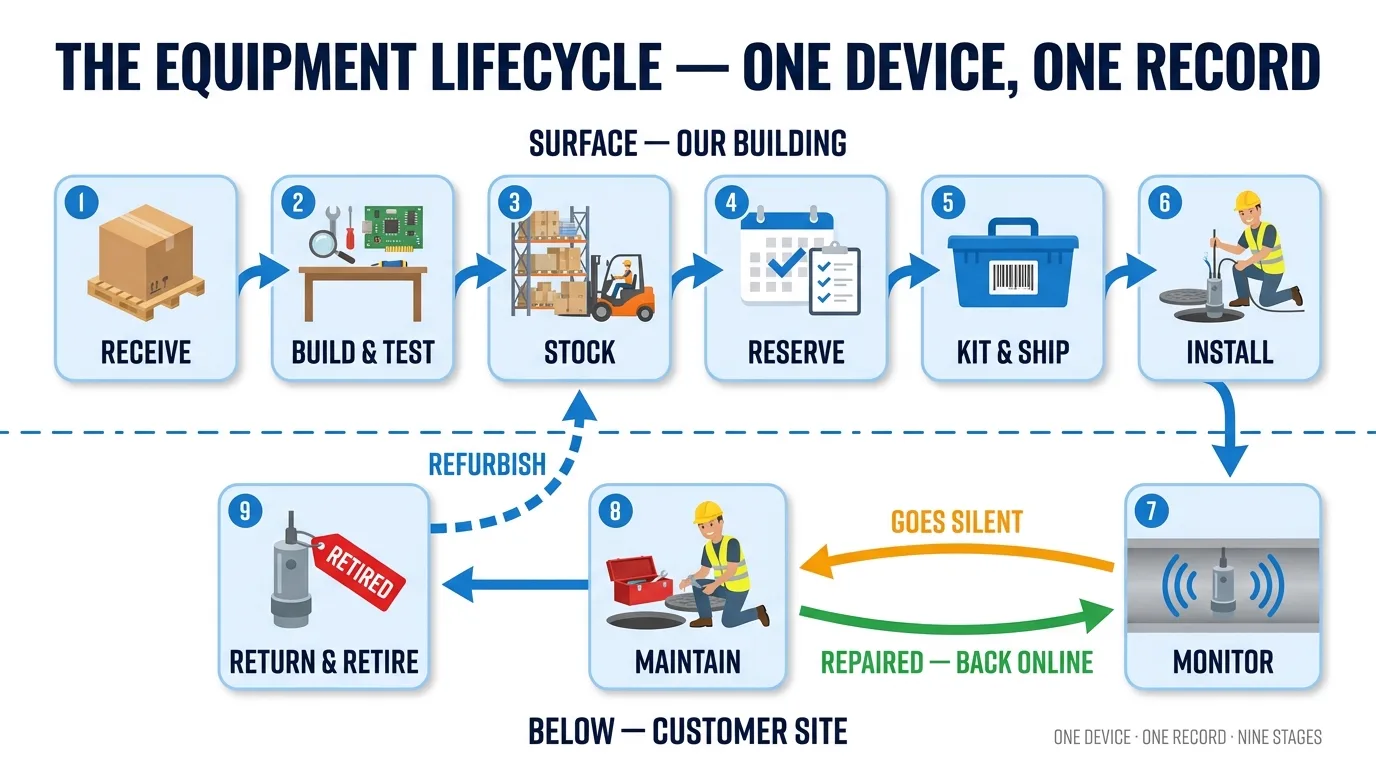
Nine stages, one record
Every device follows the same path. The job is to keep one unbroken record of it
the whole way round.
The loop is the point. Without it, a device goes in the
ground and you hear nothing until a customer calls. Close the loop and the device tells you it
stopped, someone goes out, and what they find changes how you build the next one.
03 · THE MAP
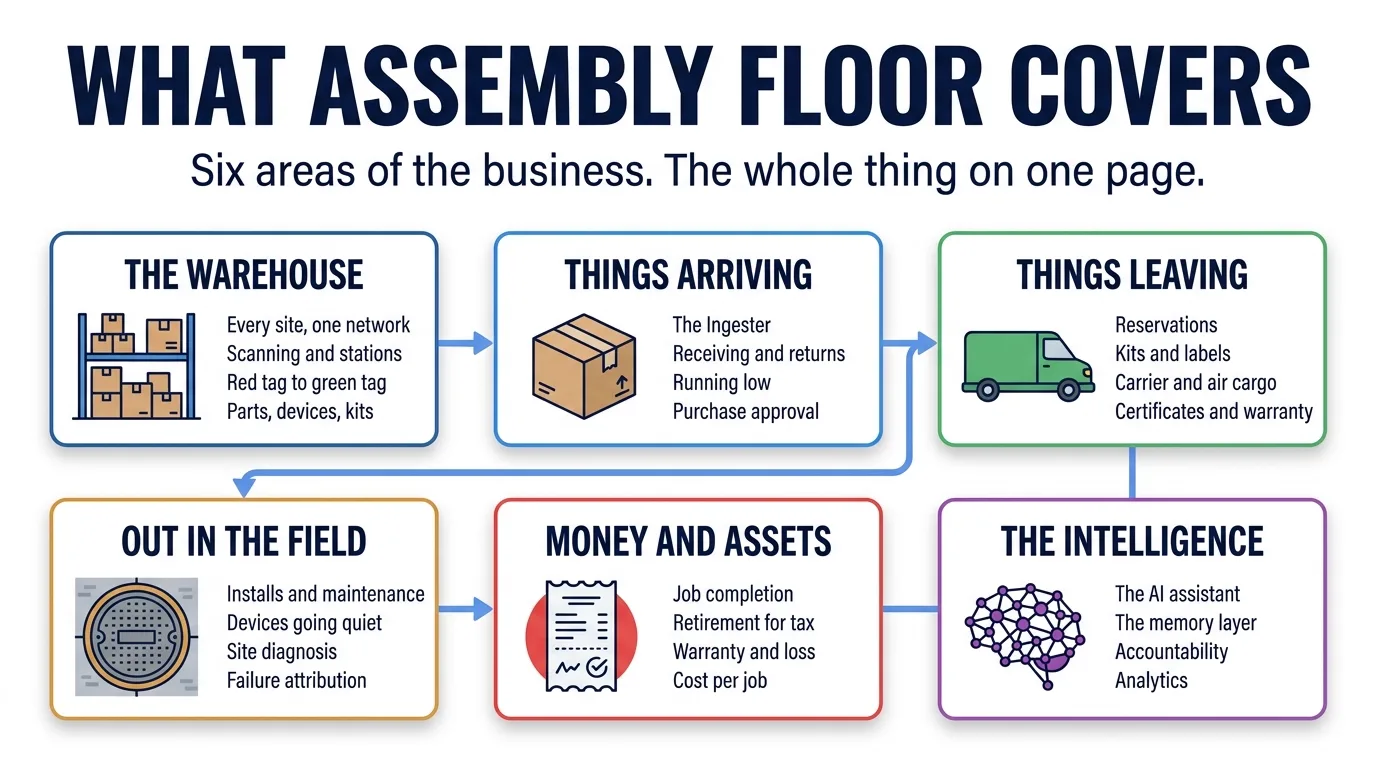
What this covers
Six areas of the business. The whole thing on one page.
04 · WHO USES IT
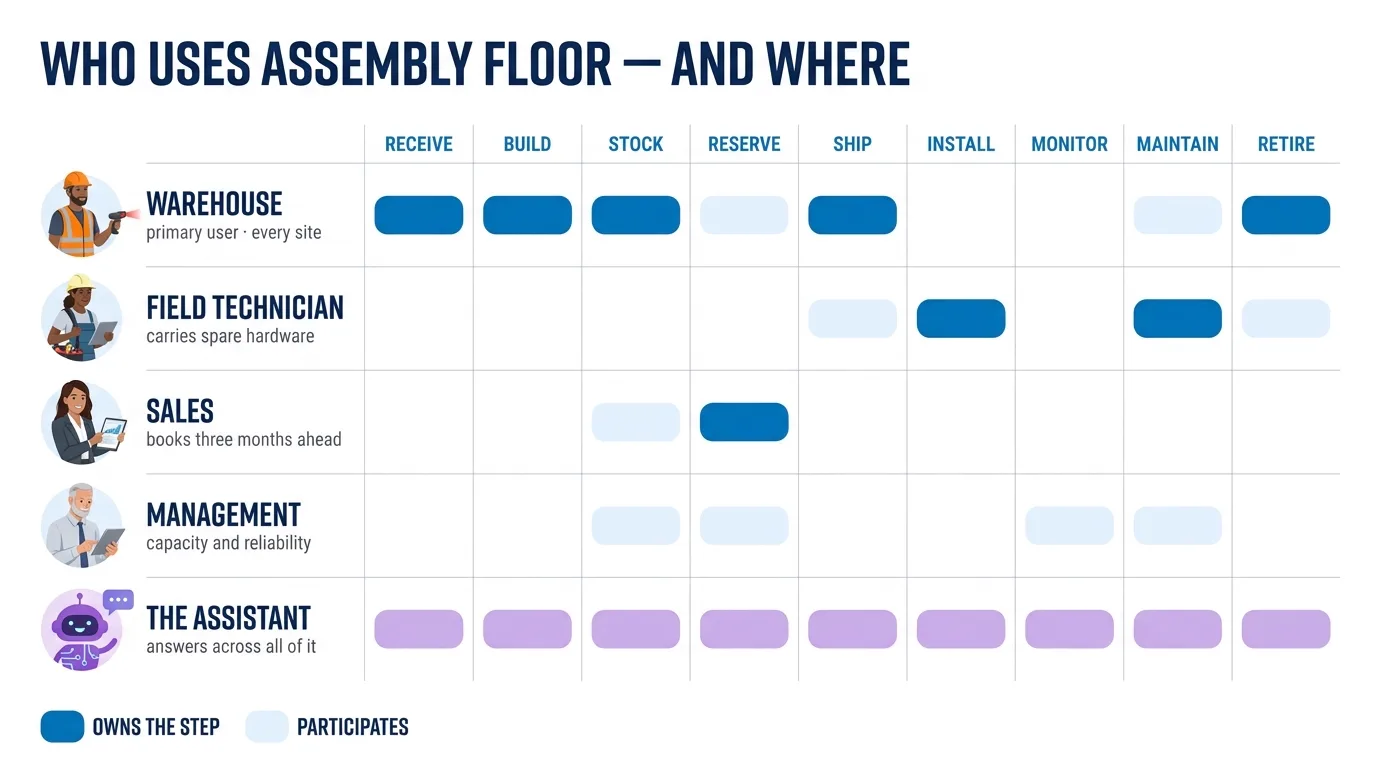
Warehouse first
Where two groups disagree, the warehouse wins. It uses more of this system than
anyone else.
05 · THE VOCABULARY
Parts, devices, kits
Three things in a fixed relationship. Everything the warehouse does sits
somewhere on this ladder.
PartCounted in bulk. Consumed when a device is built.
DeviceSerialised, with a life tracked from build to retirement.
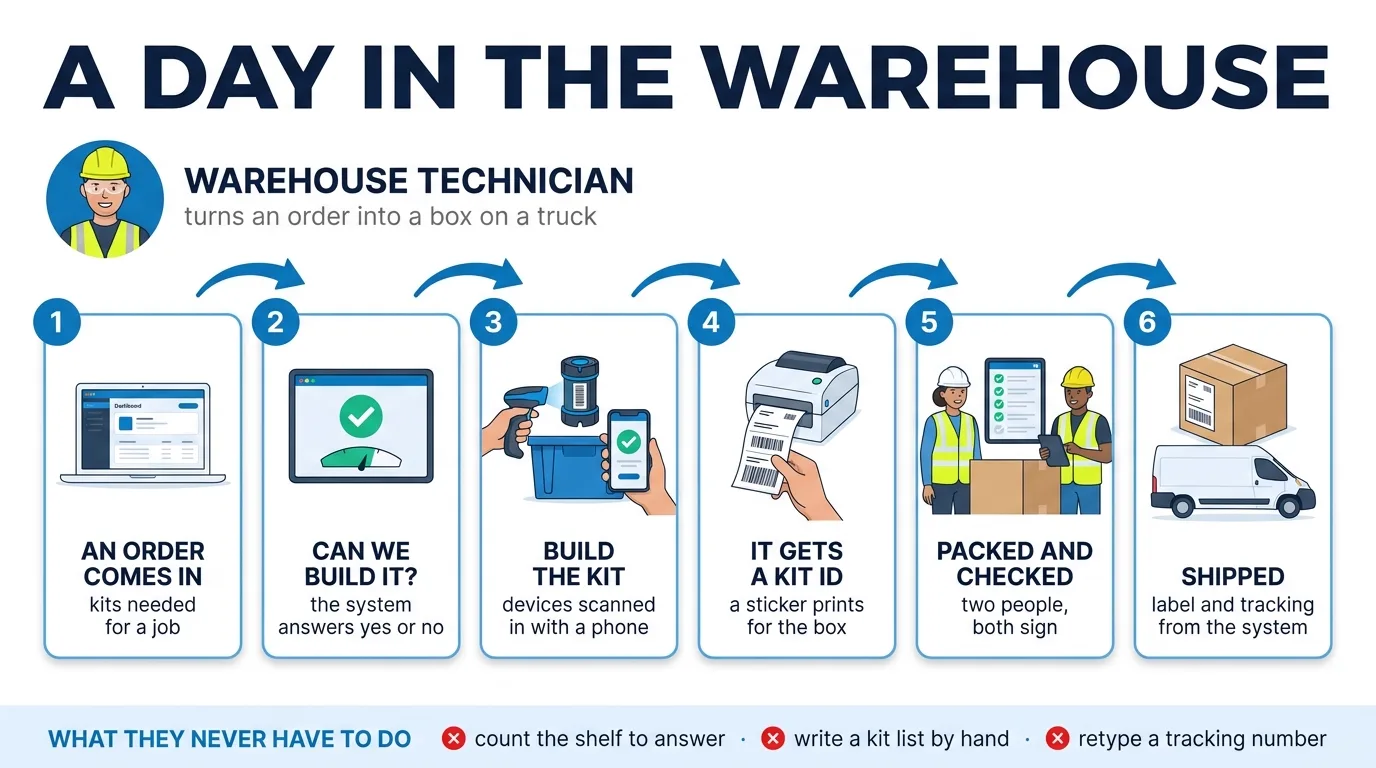
KitDevices for one job. Gets an ID and a printed sticker.
A kit dissolves when it leaves the building. Its devices
become individual devices at sites again — but the job keeps the record of which kits went out.
06 · THINGS ARRIVING
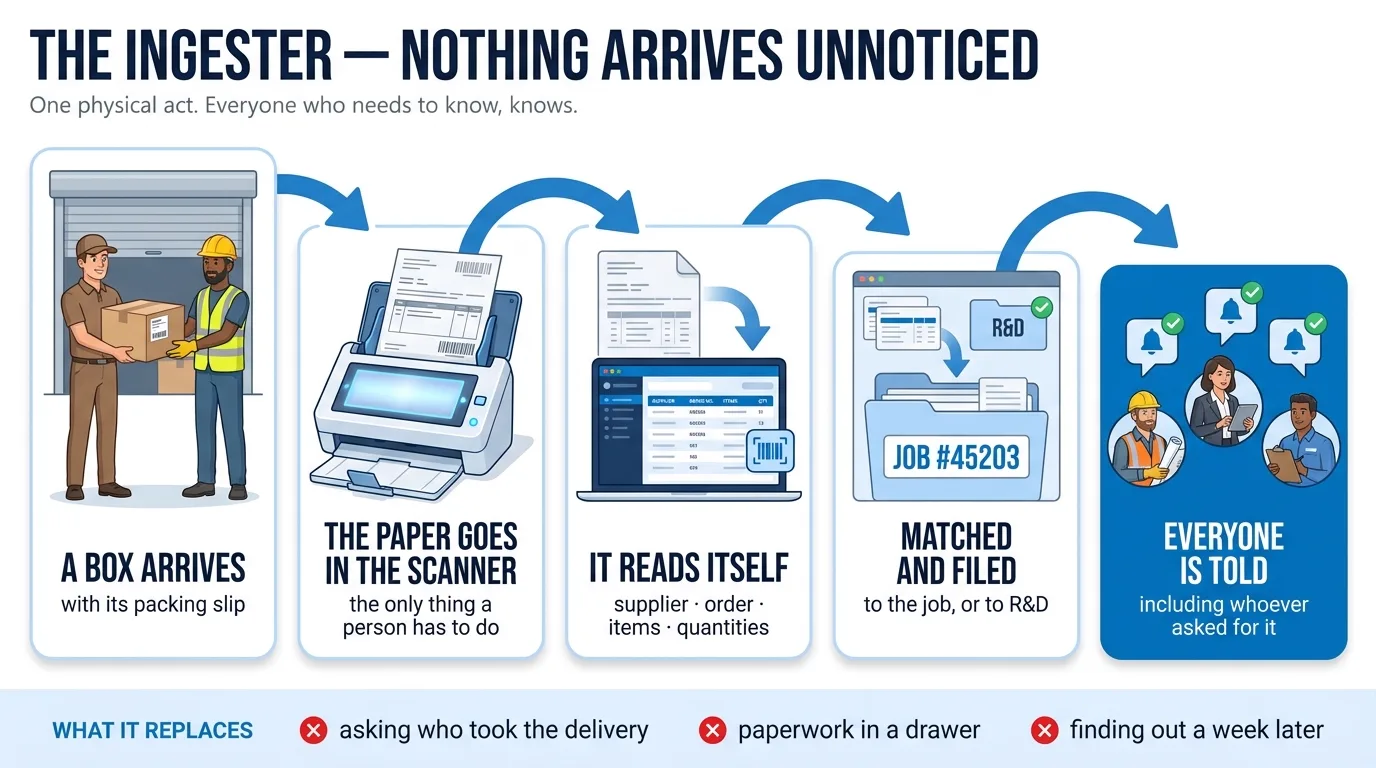
The Ingester
Every packing slip goes through one scanner. From that single act, everyone who
needs to know, knows.
Parts arrive for jobs and for research work, and the
person who asked for them has had no way of knowing they're in the building. The Ingester
reads the paperwork, matches it to an order, files it against the job — and tells whoever
requested it, automatically.
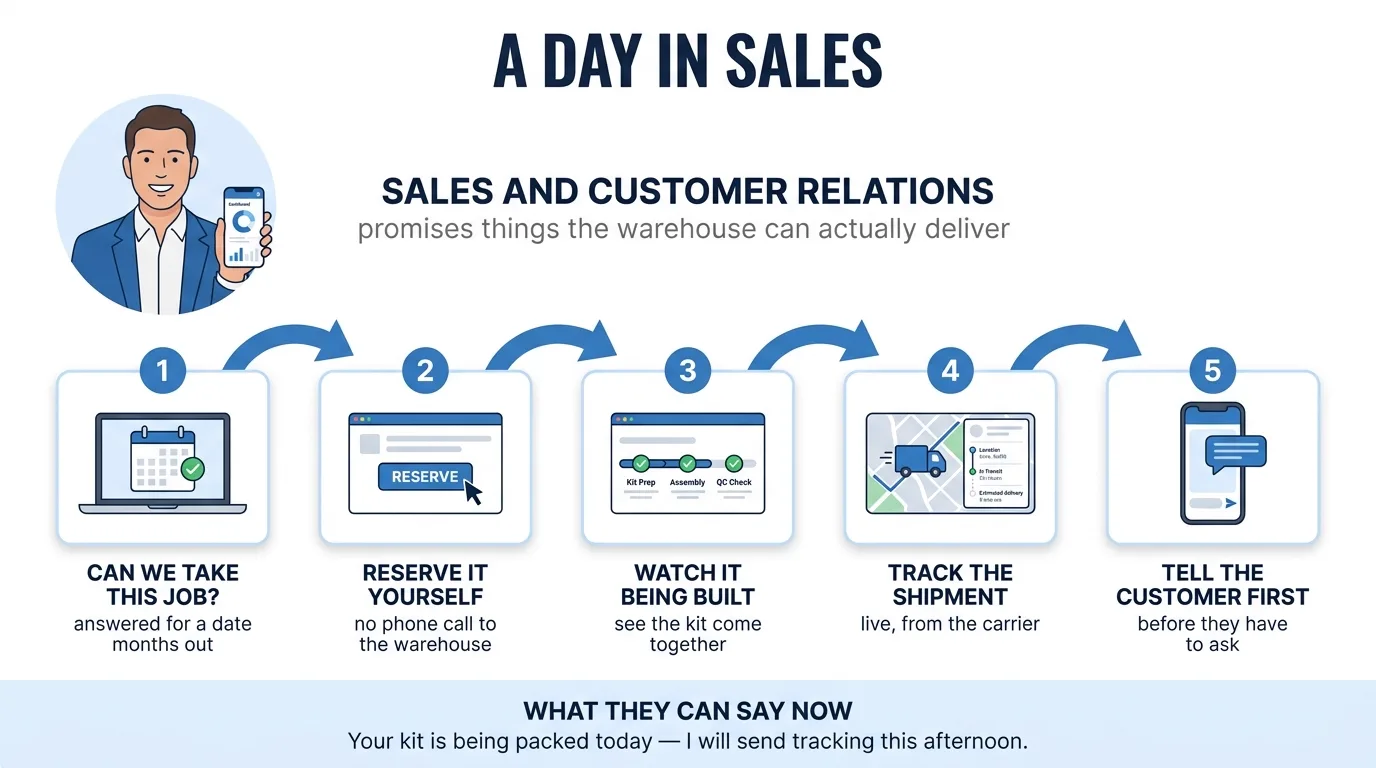
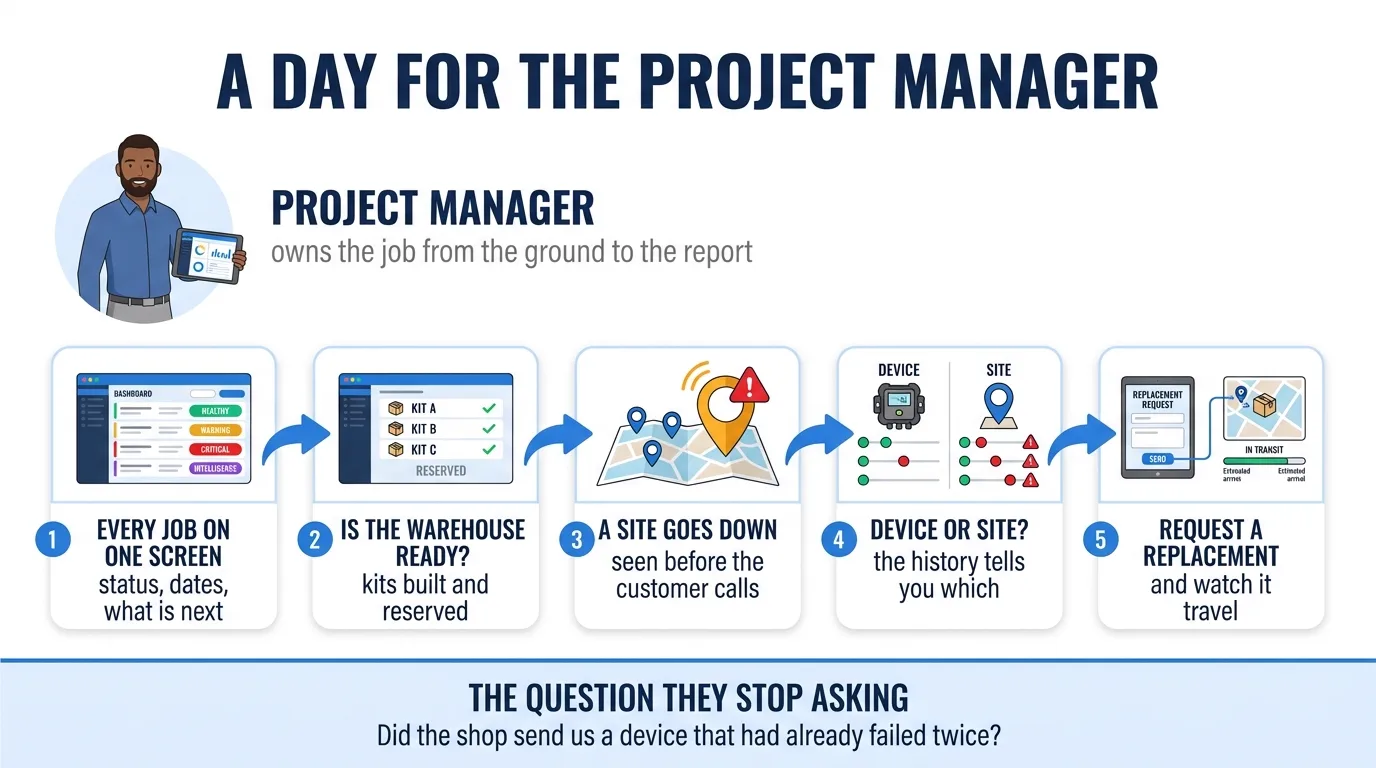
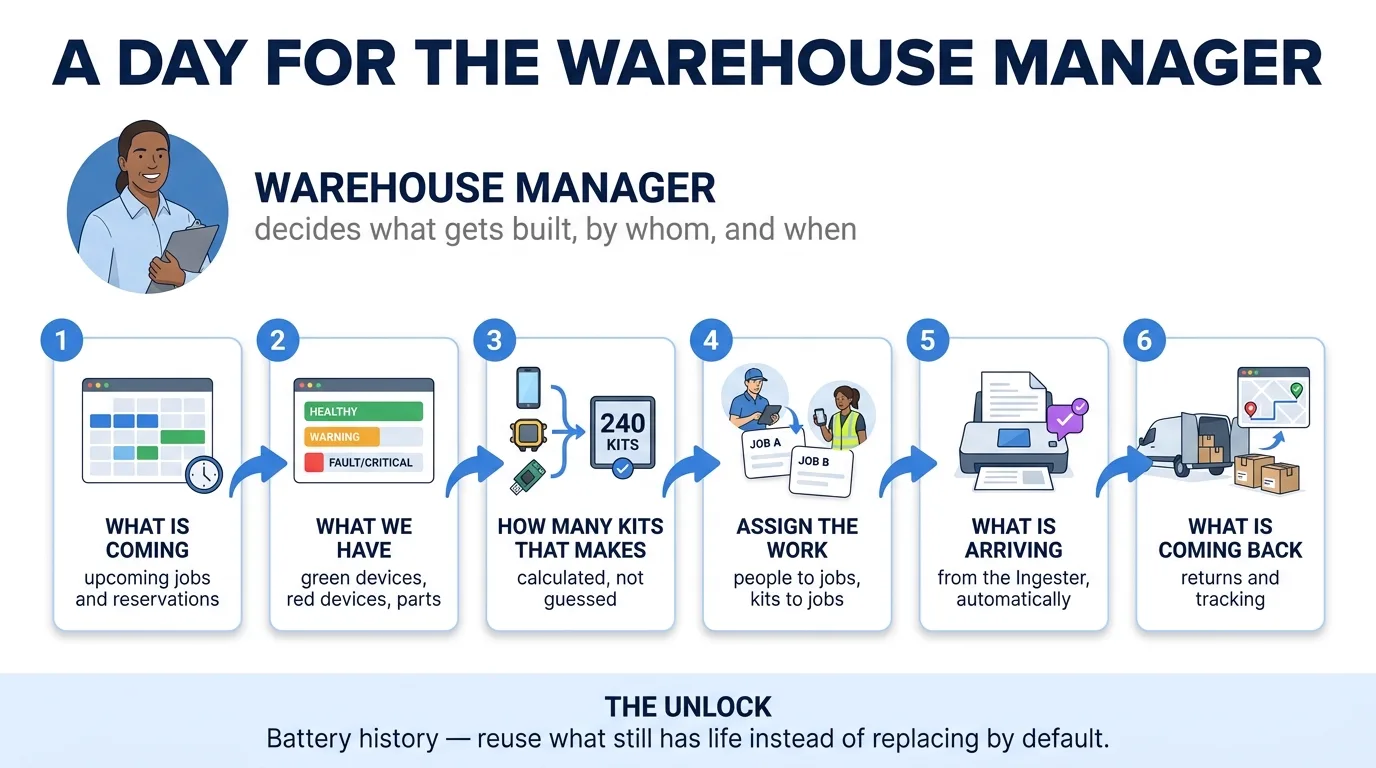
07 · THE DAY, PER PERSON
Seven seats, seven jobs
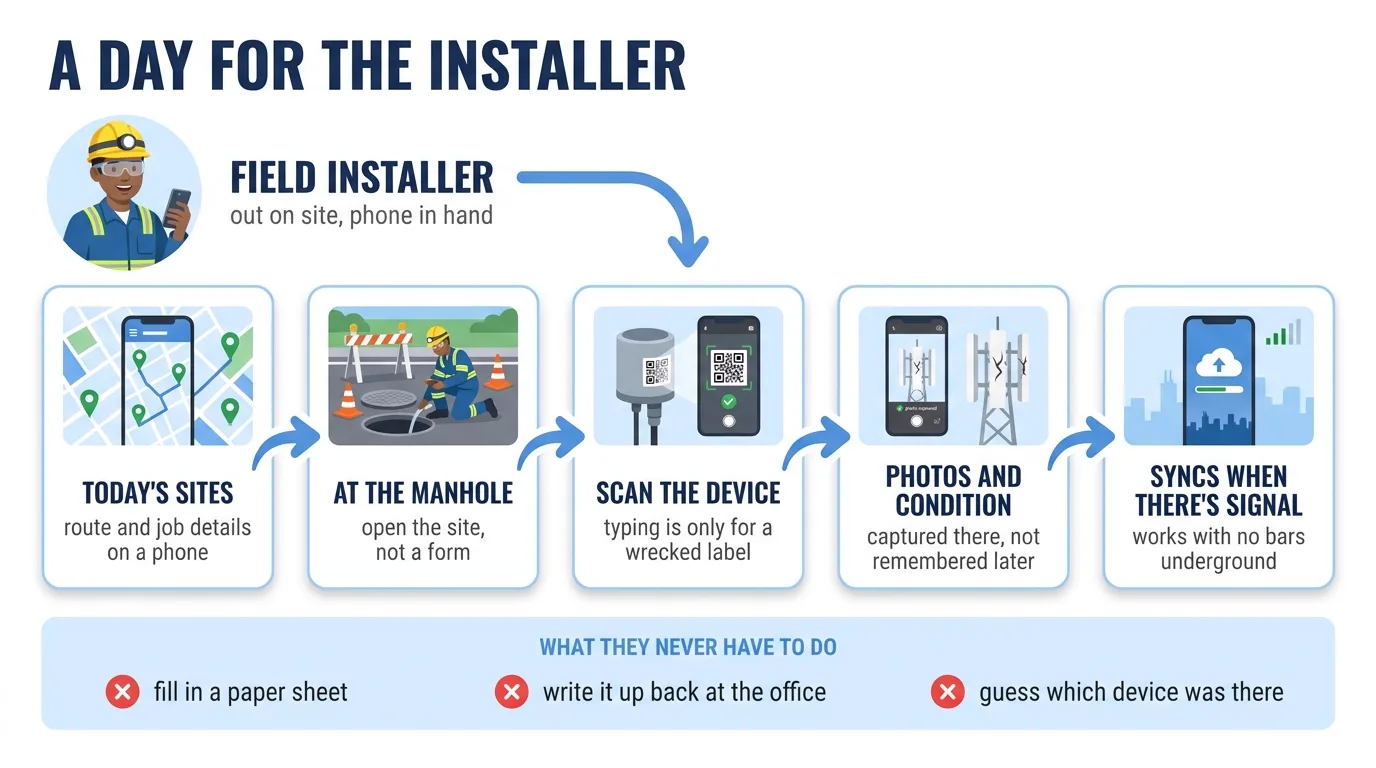
Nobody uses all of this. Everybody uses their part — and each of them stops
doing something they do today.
08 · BRINGING DEVICES BACK
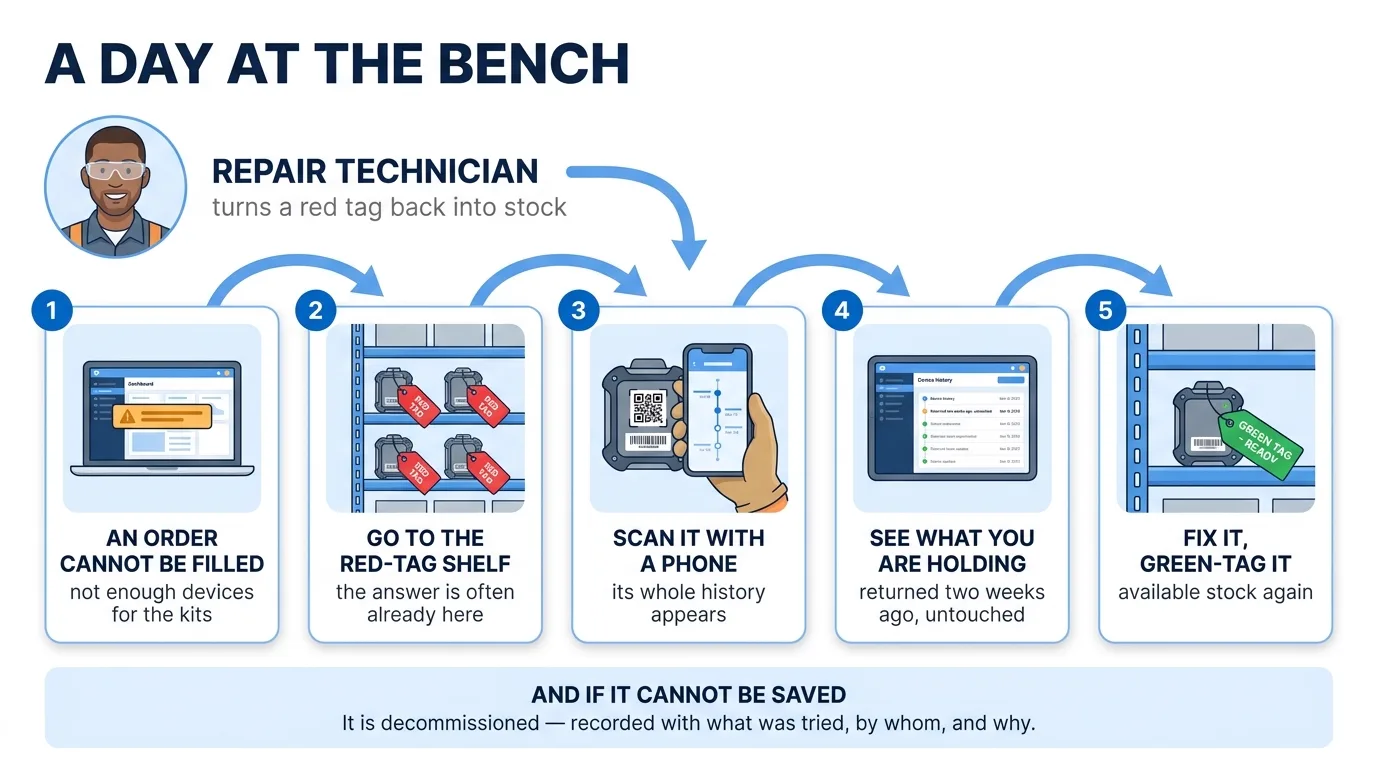
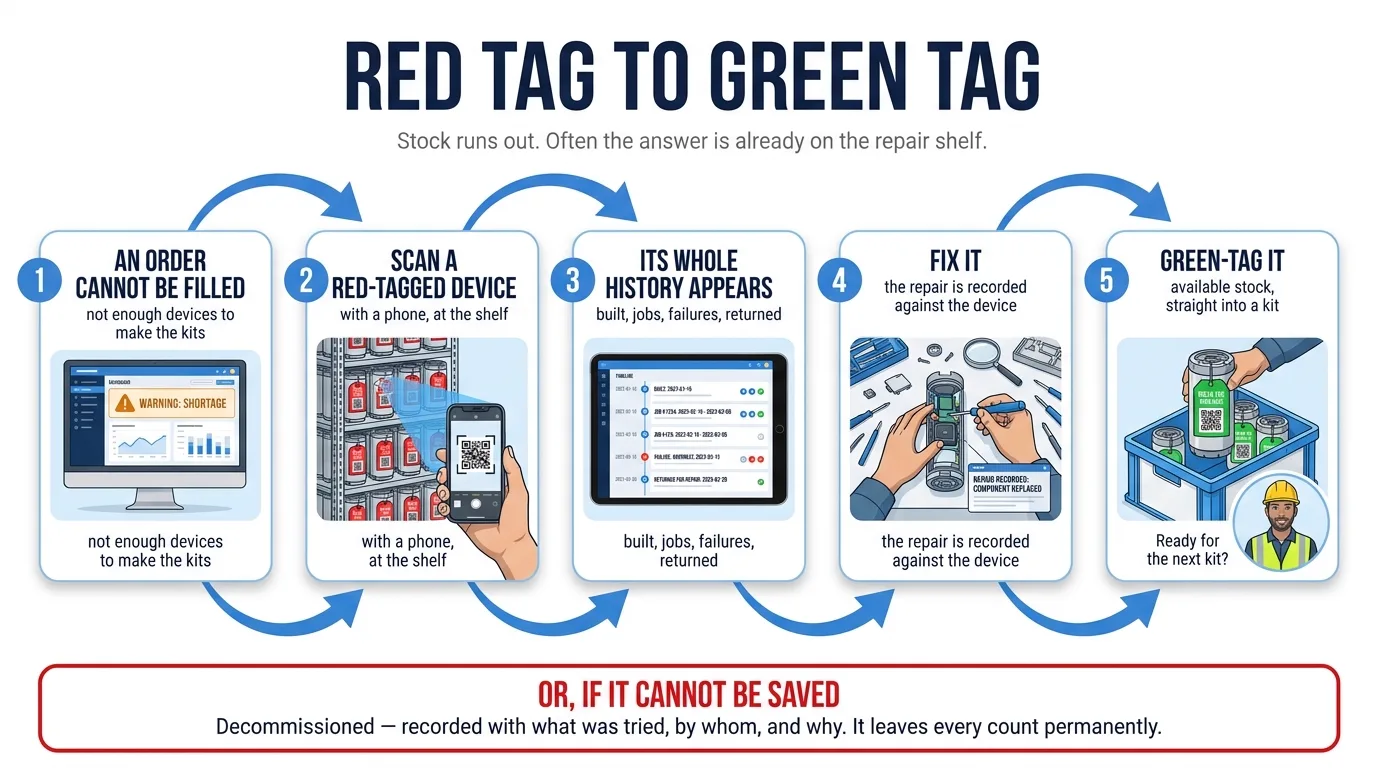
Red tag, green tag
Stock runs out. Often the answer is already sitting on the repair shelf.
If it can't be saved, the same path ends in a
decommission — recorded with what was tried, by whom, and why.
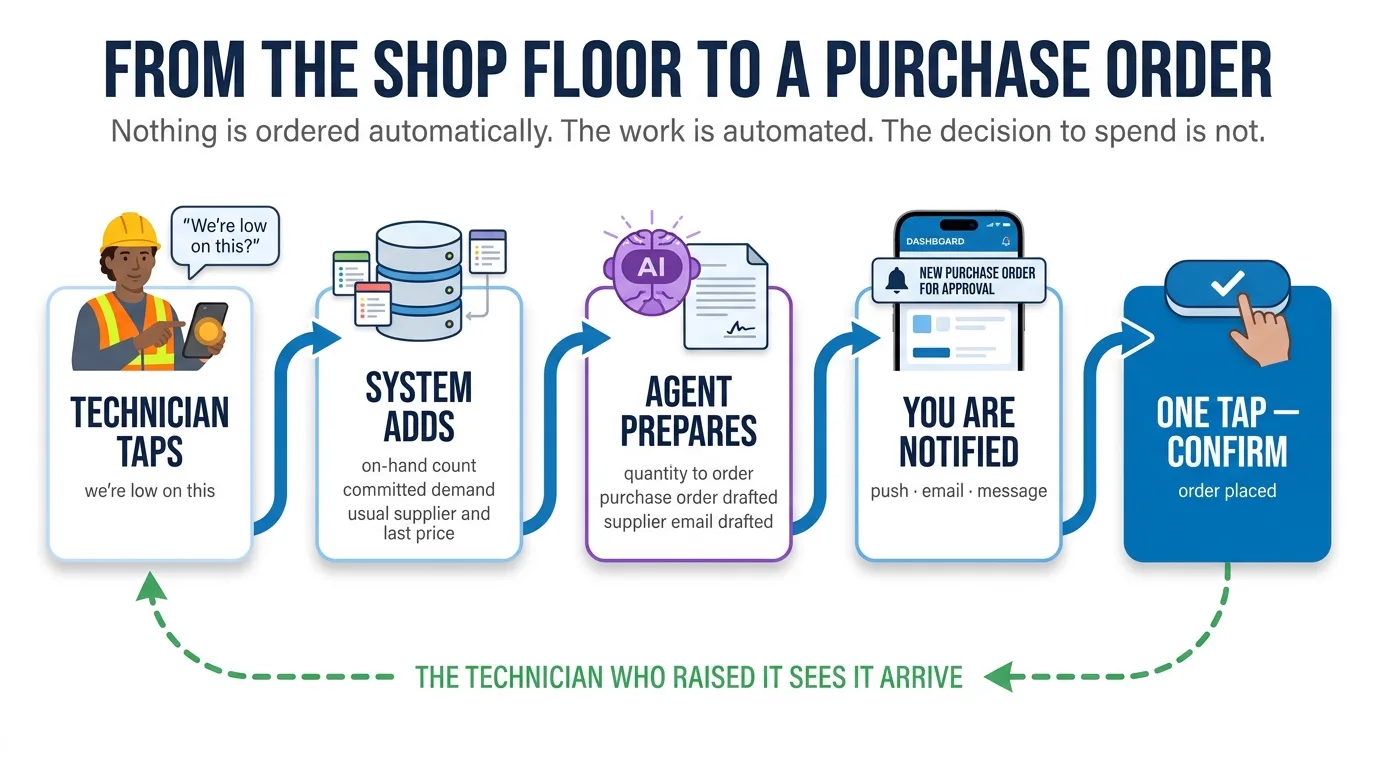
09 · RUNNING LOW
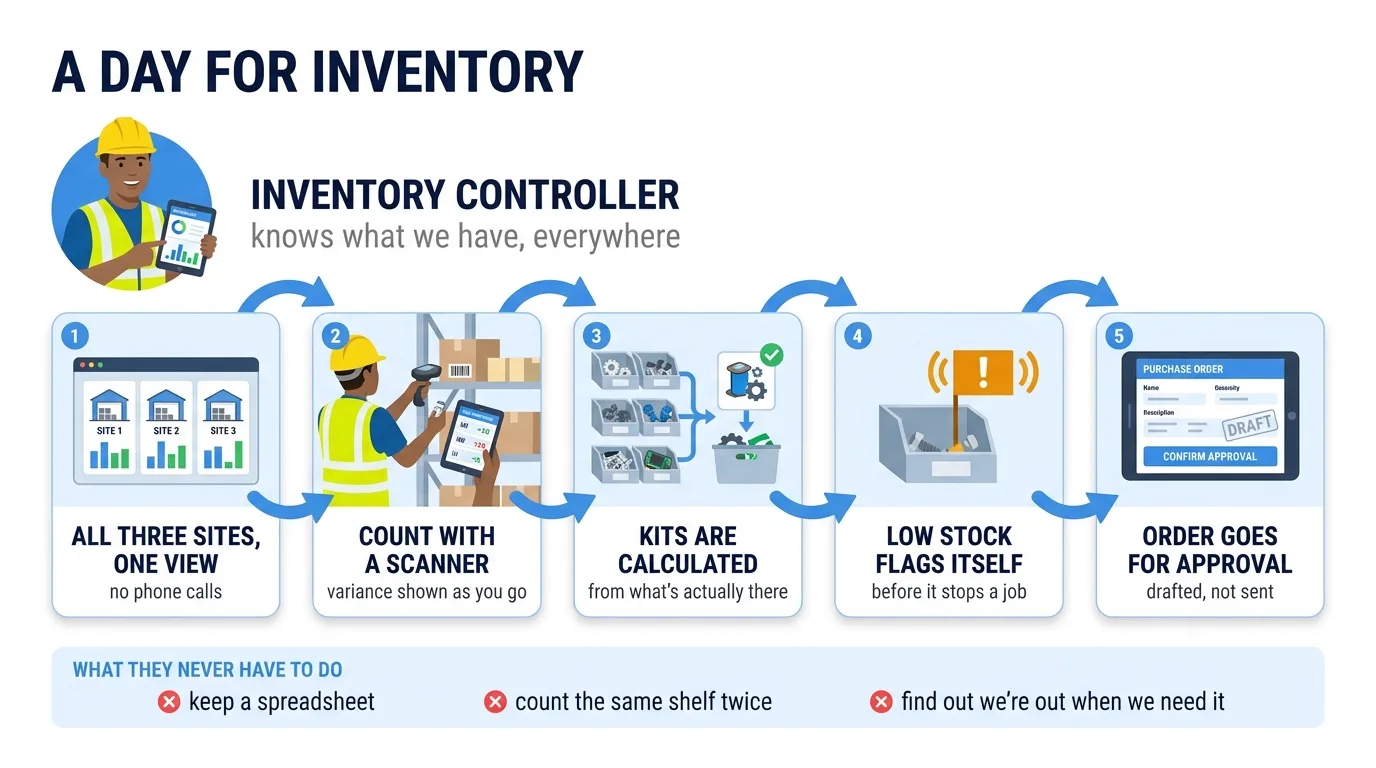
From the floor to an order
The person who knows you're running out is the one using the last of it.
Nothing is ever ordered automatically. The work of
preparing the order is automated. The decision to spend is not.
10 · GOING OUT
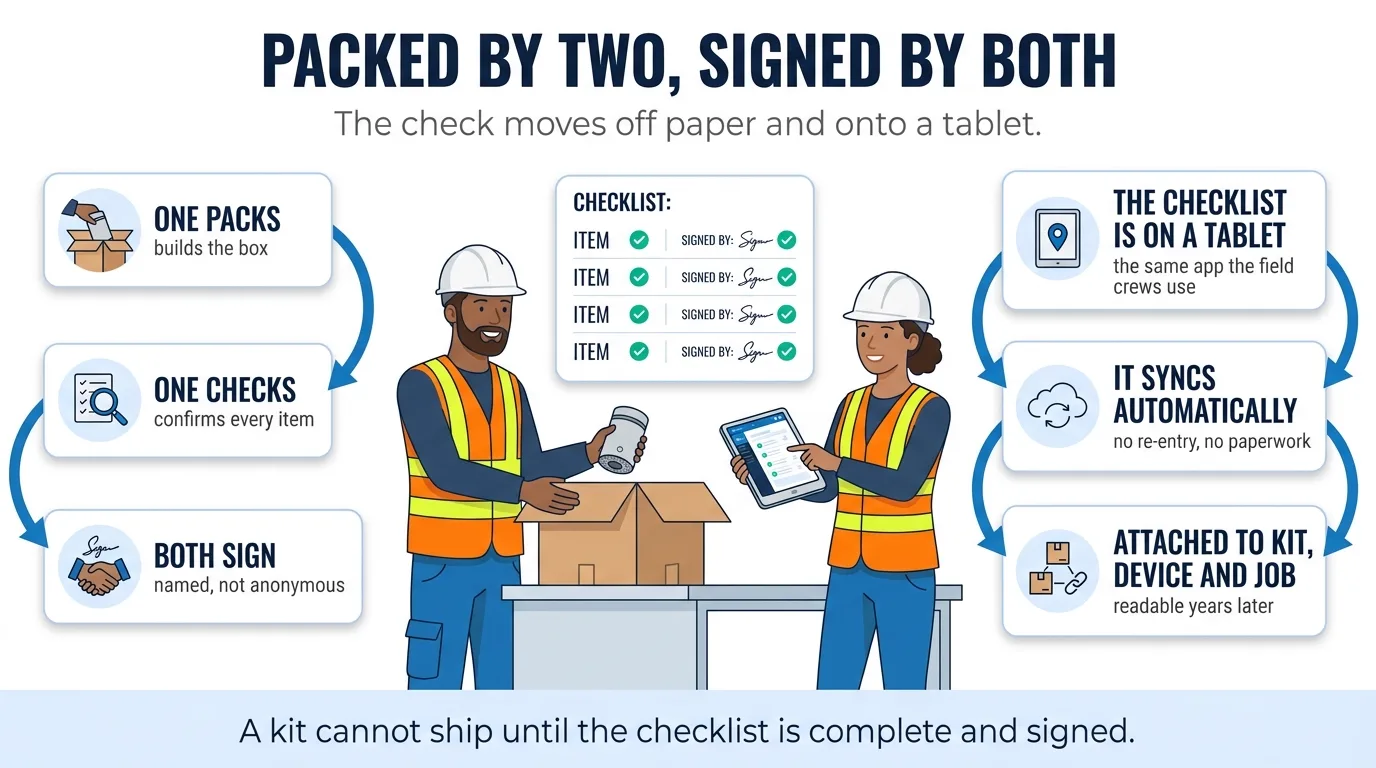
Packed by two, signed by both
Packing a box is a two-person job: one packs, one checks. That check moves off
paper and onto a tablet.
A kit cannot ship until the checklist is complete and
signed. It stays readable — from the kit, every device in it, and the job — years later.
11 · PROVING IT WORKS
Calibration and the sales pack
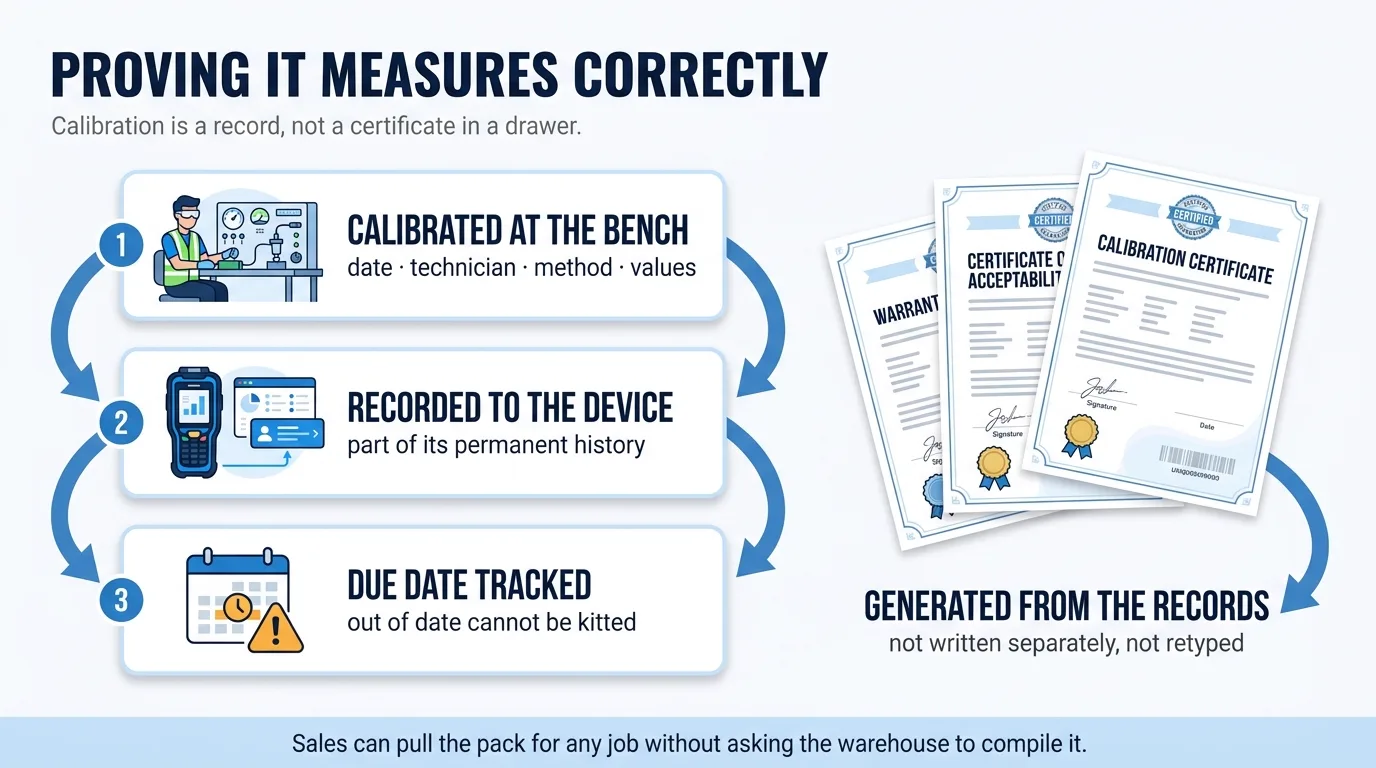
An instrument is only trusted if it can prove it measures correctly.
Calibration is captured at the bench and becomes part of
the device's permanent record rather than a certificate in a drawer. A sales kit must carry
its certificate of acceptability and its calibration certificate — and a device outside its
calibration period cannot go into one. Those documents are generated from the records, and
sales can pull the pack for any job without asking the warehouse to compile it.
12 · EVERY DEVICE
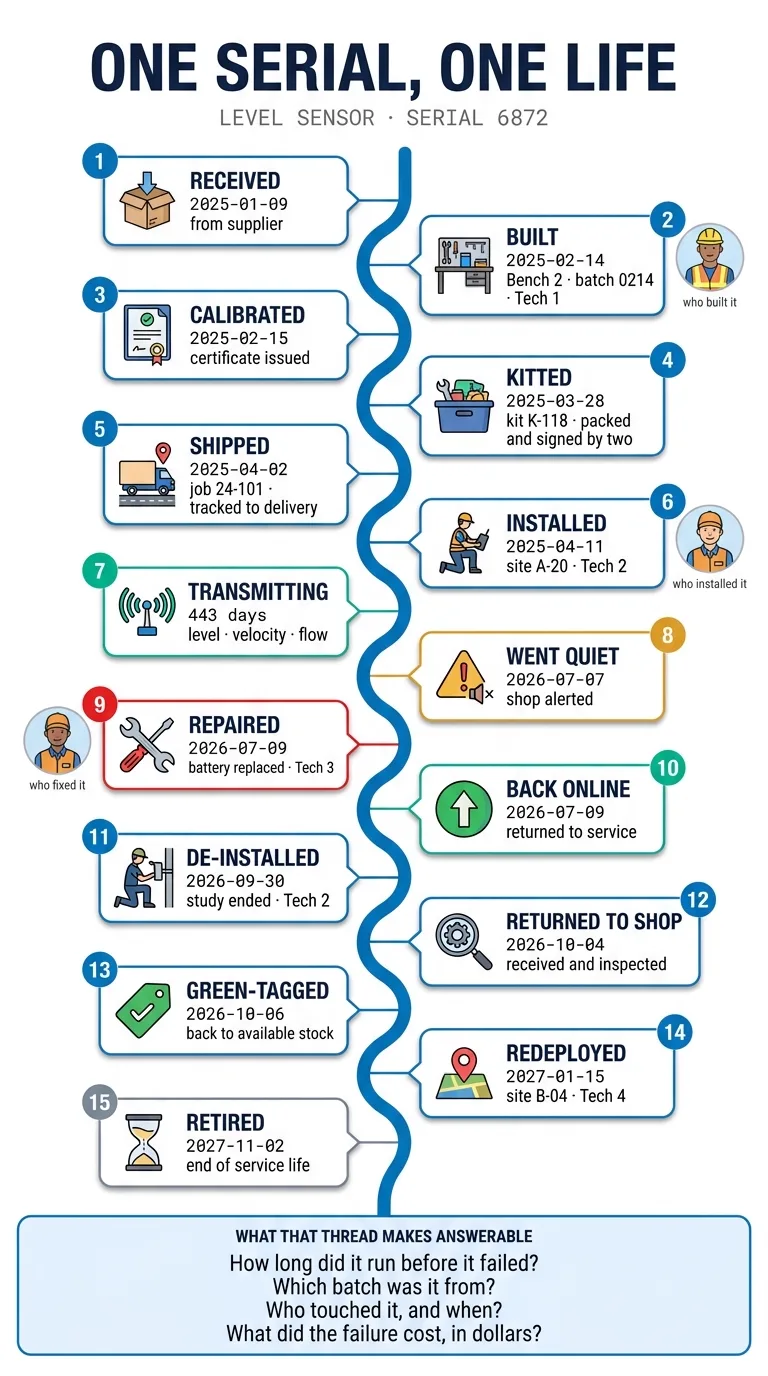
One serial, one life
A device isn't a row in a stock list. It's an object with a history — and the
history is what makes everything else possible.
Built on a named bench in a named batch. Shipped in a named kit, packed and
signed by two people. Installed by a named technician at a named site. Transmitting, then
quiet. Repaired, returned, redeployed. Eventually retired, with the reason recorded.
Read along that line and you can answer: how long it ran, which batch it came
from, who touched it, and what the failure cost.
13 · DIAGNOSIS
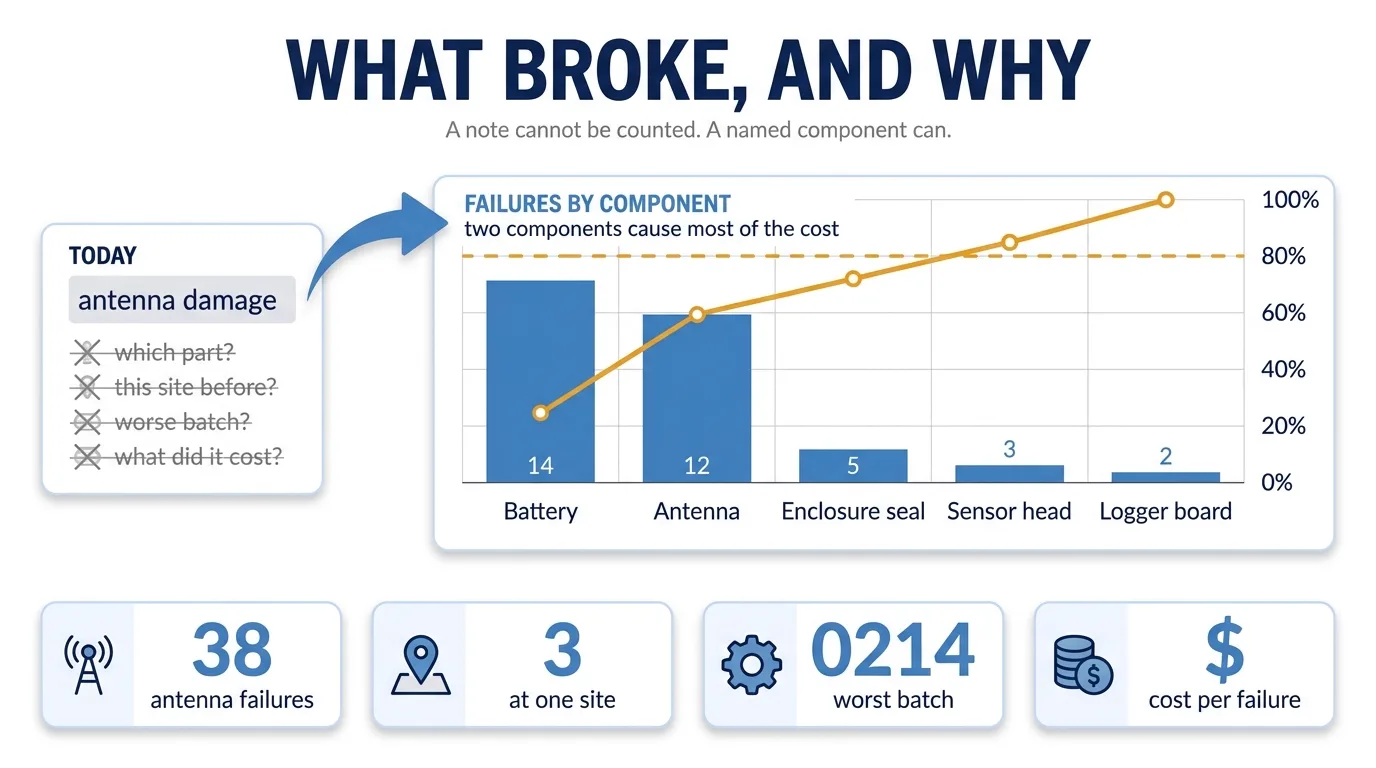
What broke, and why
“Antenna damage” in a box is a note. The same failure against a named part,
counted across the fleet, is a diagnosis.
Two components cause most of the cost. You cannot see
that from free text.
14 · DIAGNOSIS
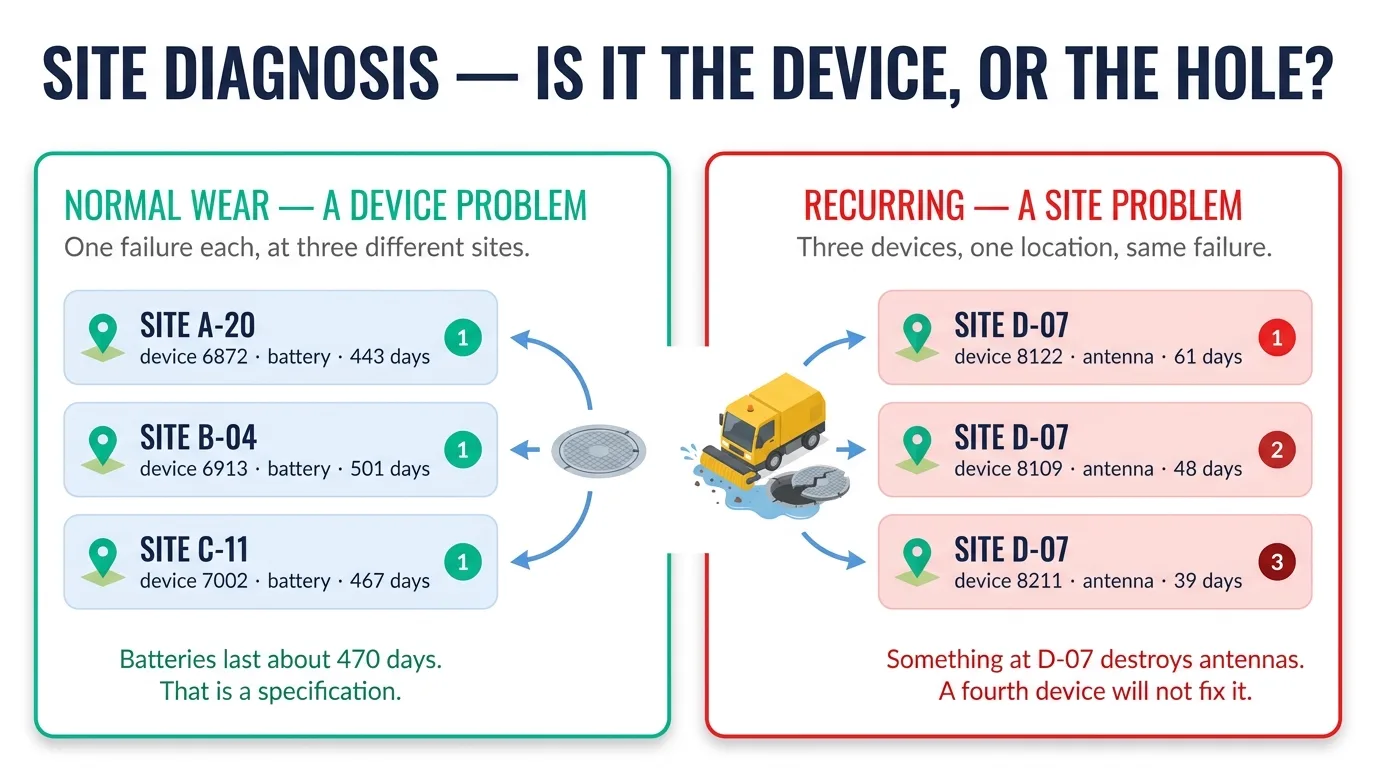
Is it the device, or the hole?
Some manholes eat equipment. Replace the device and it fails again, because the
device was never the problem.
This only works because repair history hangs off the
site, not the device — so it survives every swap.
15 · THE FIELD, WATCHED
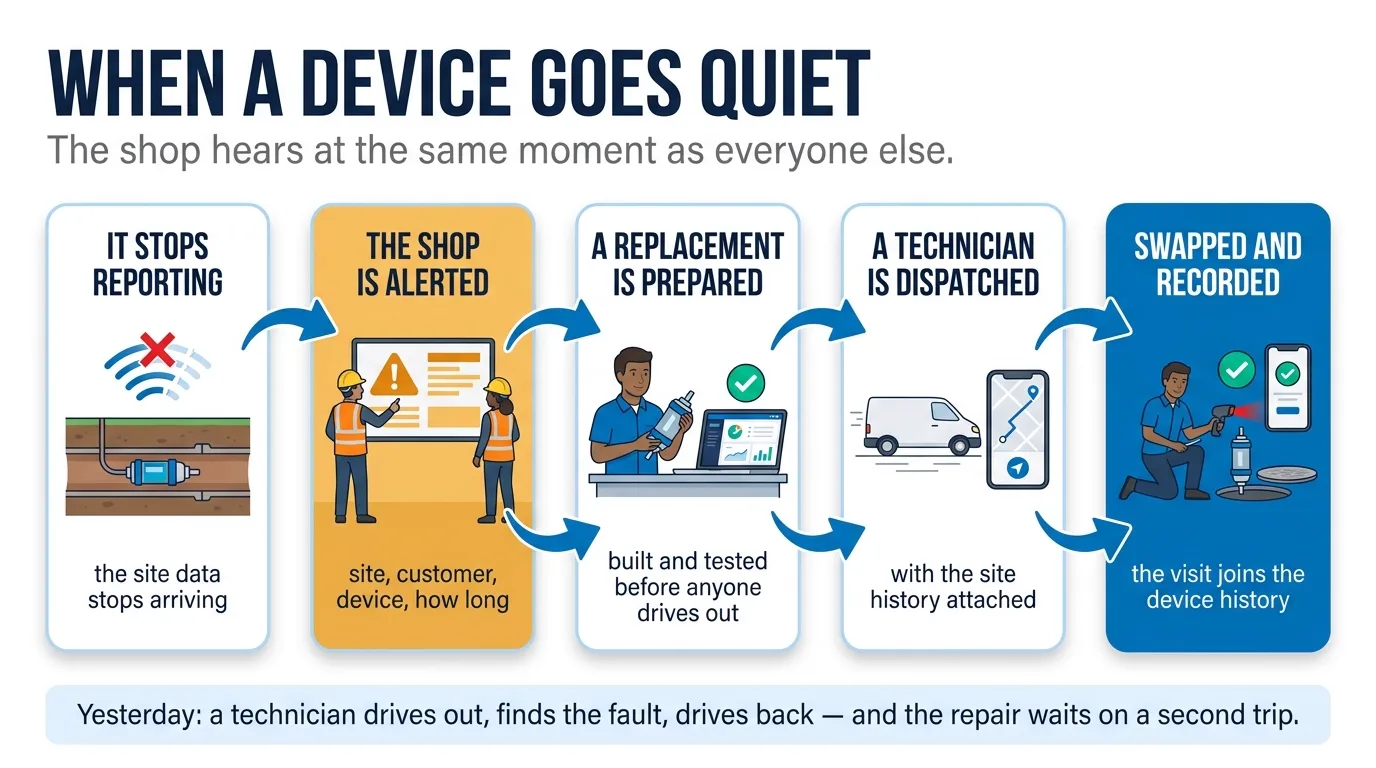
When a device goes quiet
Without the watcher, a device dies in the ground and you find out when the
customer rings.
The warehouse hears at the same moment as everyone else —
so the replacement is built and tested while the visit is still being scheduled. Devices
switched off on purpose never alert: a disposition gate separates outage from maintenance from
dormancy, so an alarm means something every time.
16 · A HUGE UNLOCK
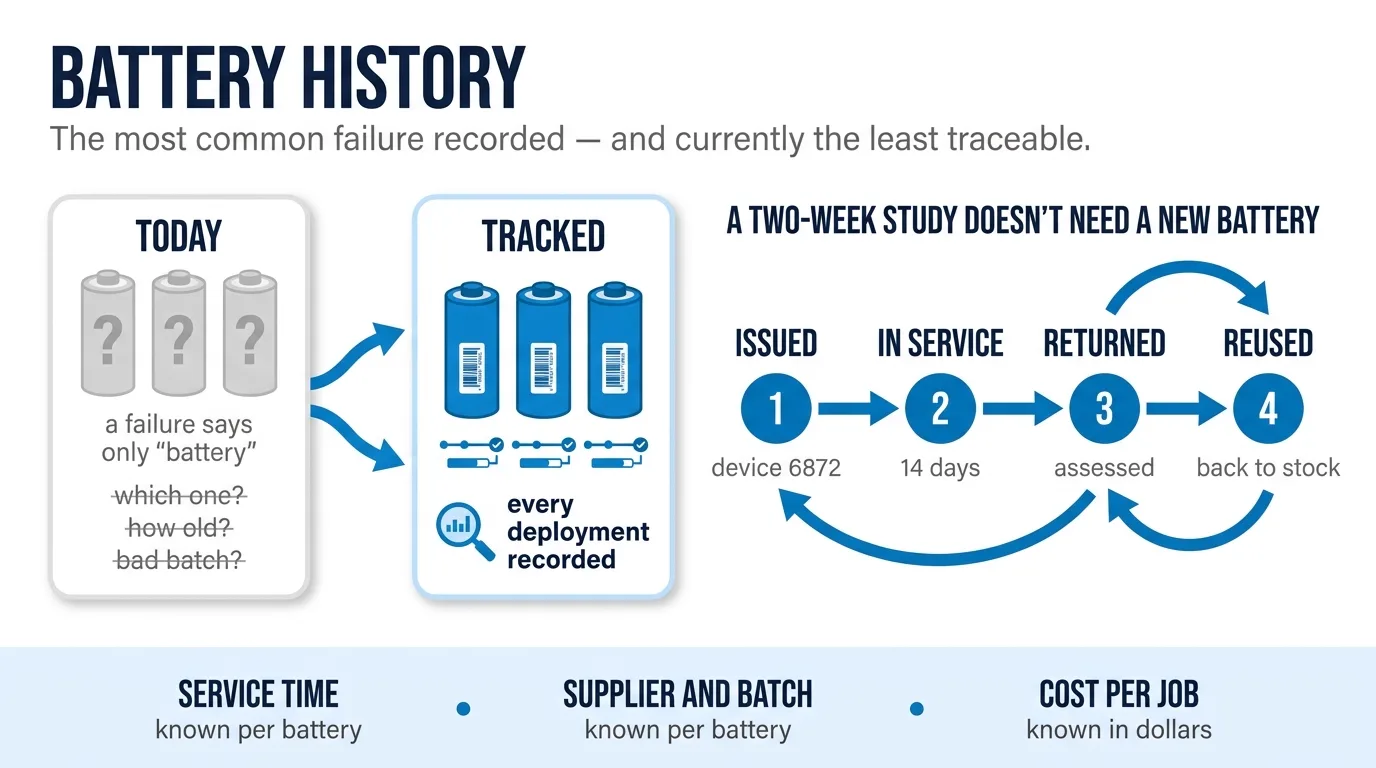
Battery history
Battery is the most common failure recorded — and currently the least traceable.
17 · ACCOUNTABILITY
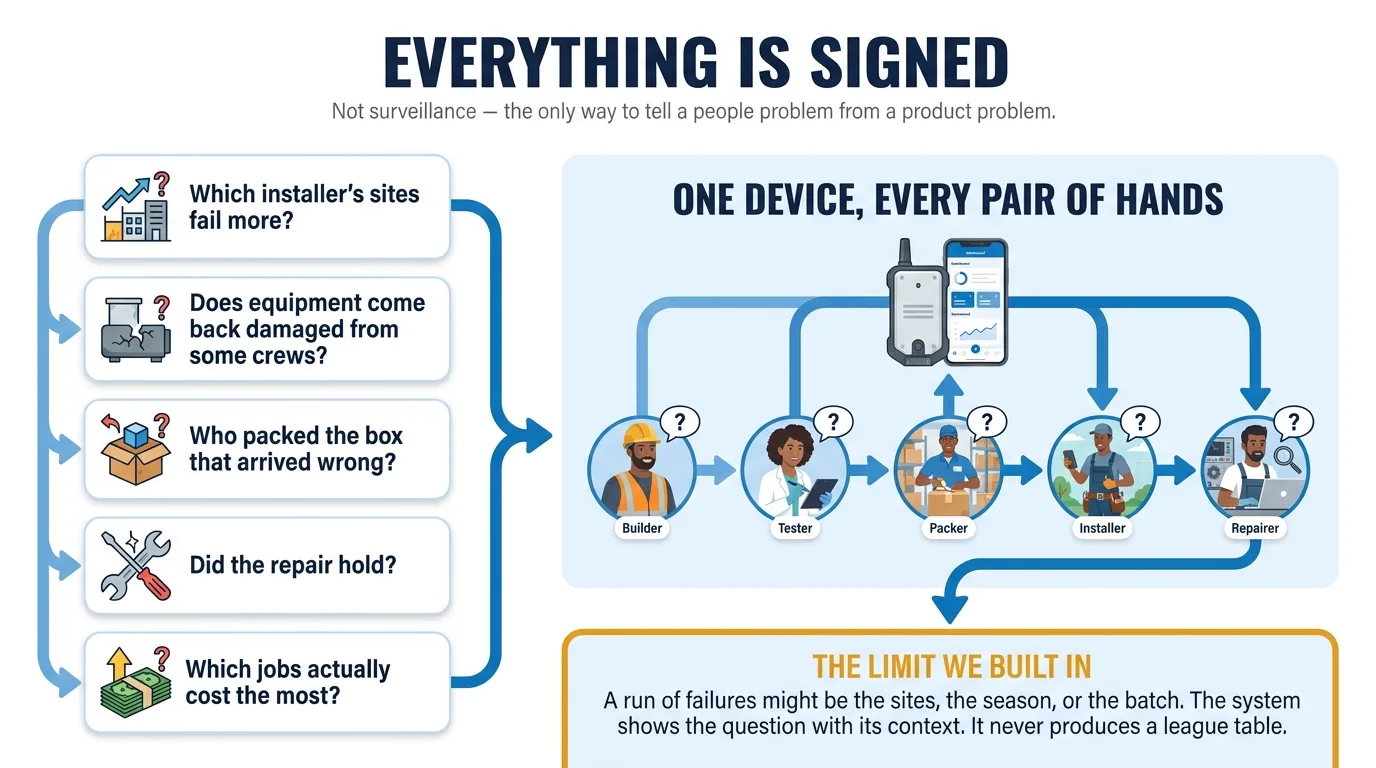
Everything is signed
Not surveillance — the only way to tell a people problem from a process problem
from a product problem.
A deliberate limit. A run of failures might be the sites,
the season, or the batch. The system shows the question with its context.
It never produces a league table.
18 · WHAT THE DATA PAYS BACK
Analytics, money and the awkward cases
Once every step is recorded, a set of questions that used to need a phone call
answer themselves.
Job endedEquipment back in the shop, or a rental finished — accounting told without chasing.
WarrantiesWhat you owe the customer, and what the supplier owes you.
Shipping historyEverything ever sent to a customer, with tracking.
Test historyProof of what left the building, and in what condition.
Certificates per jobCalibration and acceptability, assembled per shipment.
Consumables per jobDesiccant, ties, hardware — or job cost is understated.
Customer-owned equipment is marked as theirs from the
moment it arrives — it never enters your stock, your asset counts or your retirements, even
though you service it with the same detail. Add carrier data and maintenance history together
and cost per project stops being an estimate: parts, shipping, labour, travel and rework, per job.
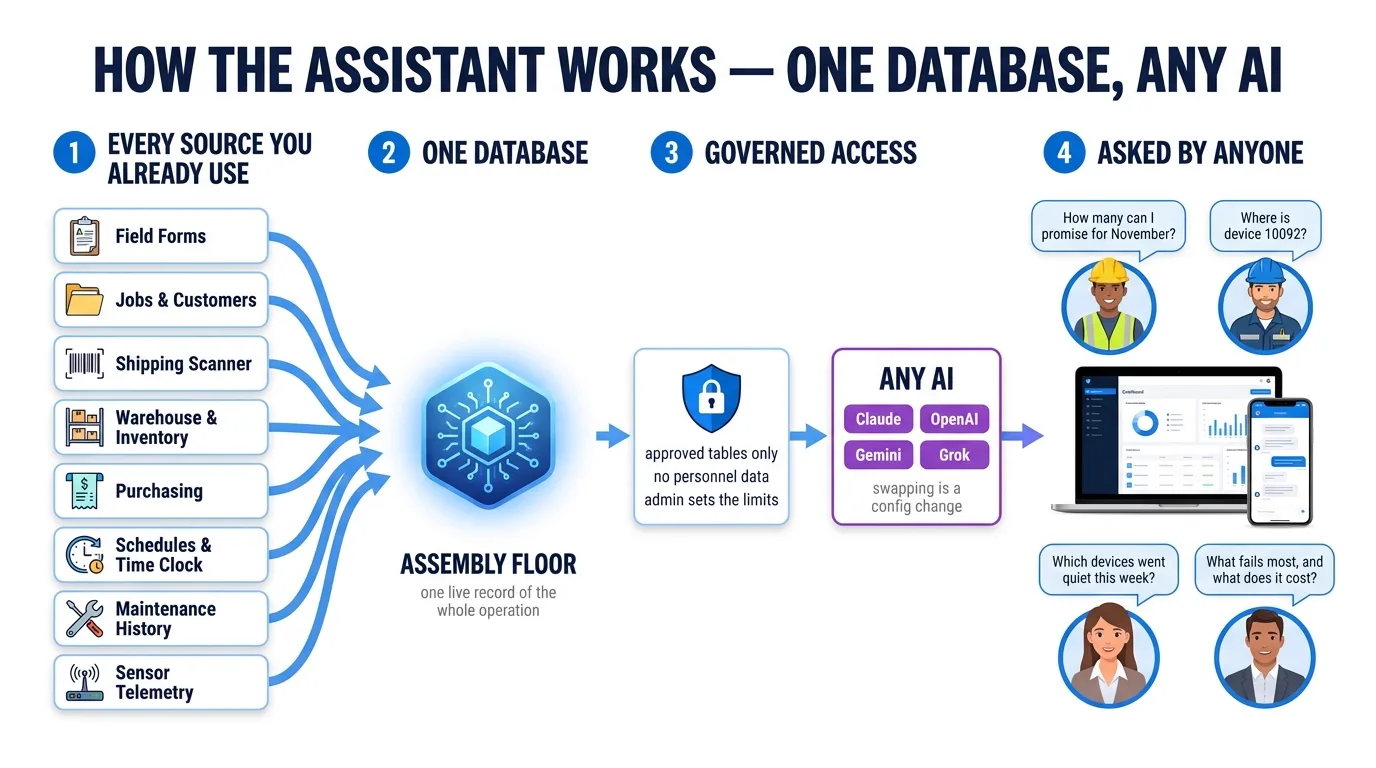
19 · ASK IT ANYTHING
The Foreman
Every number in the system, in plain language, without knowing where it's kept.
Charged on what it's used for, not per person. No
licences to buy, and you can switch AI provider whenever you like — swapping is a config
change, not a rebuild.
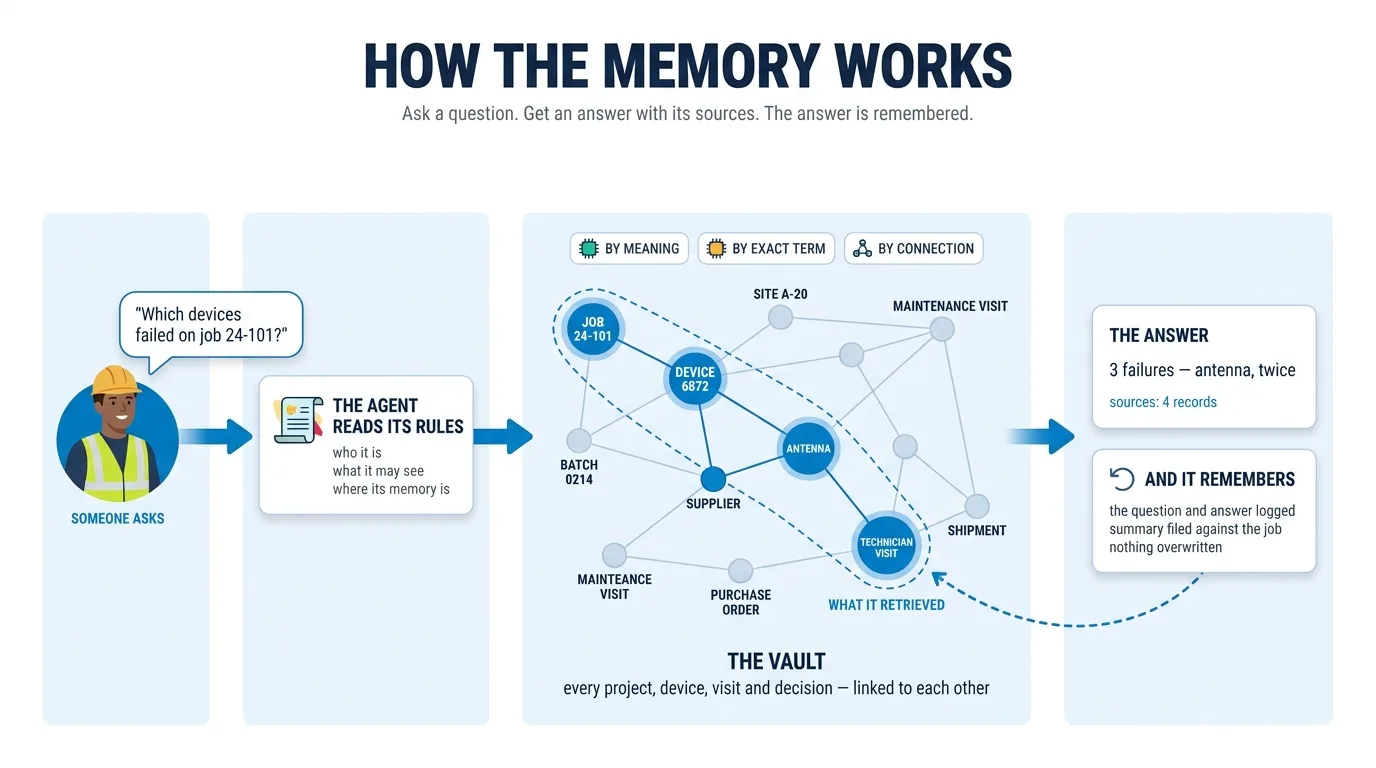
20 · UNDERNEATH IT
The memory it runs on
The Foreman isn't a chatbot bolted on. It runs on a memory layer every future
agent will share.
Append-onlyNothing is ever overwritten.
SourcesAnswers carry sources — anything can be checked.
Permissions firstRestricted data is never fetched.
Behaviour is dataChange it with an edit, not a release.
It can live wherever you want it — including inside your
existing Microsoft estate. That's a hosting decision, not a rebuild.
21 · ORDER OF WORK
How it gets built
Warehouse first. Each stage is useful on its own.
1 WarehouseEvery site as one, kits, red tags, the shipping record.
2 The floorTask lists, the Ingester, low stock to purchase order.
3 CommitmentSales can see and hold what's free months out.
5 ShippingLabels, tracking, air cargo — visible to sales and accounting.
6 WatchingLive device data and the gone-quiet alert.
7 ReliabilityPassports, component failures, site diagnosis, cost.
8 IntelligenceThe Foreman across all of it.
22 · HONESTY CHECK
Where this comes from
This explainer describes the finished system. It was written inside a working
wastewater instrumentation manufacturer, and the platform is being built in that order of
work — warehouse first, each stage useful on its own.
RUNNING ON A REAL FLOOR
The Ingester, feeding the assistant · scanning and stations · jobs and sites syncing · field install records · the assistant itself · daily backups.
PARTLY THERE
Inventory and kits · multi-warehouse rollout · device states · maintenance capture · live device data proven, not yet continuous.
We publish this because you'd find out anyway — and
because the fastest way to make it wrong is to show it to people who run floors.
The current state always lives on the transparency page.