Assembly Floor Book a demo
A business operating system for manufacturers

Assembly
Floor One record for the whole operation.

Your warehouse, your field crews, your equipment in the ground — and everything you know about it — in one live system your whole company can ask.

WAREHOUSEFIELDFLEETINTELLIGENCE
The week you know too well

Hardware companies run on
questions nobody can answer.

MONITOR

A device dies in the ground.

You find out when the customer calls. The repair waits on a second trip.

SHIP

A box ships wrong.

Nobody can say who packed it, who checked it, or what was actually inside.

COUNT

The part nobody logged.

So the job cost is a guess, the warranty is a shrug, and the answer is a walk to the warehouse.

None of this is a people problem. It is a record problem — the company knows these answers, but no single system holds them.

How it fits together RECEIVE → RETIRE

Nine stages. One record.

Every device follows the same path: received, built, stocked, reserved, kitted, installed — then monitored in the ground, maintained, and eventually retired. Assembly Floor keeps one unbroken record of it the whole way round.
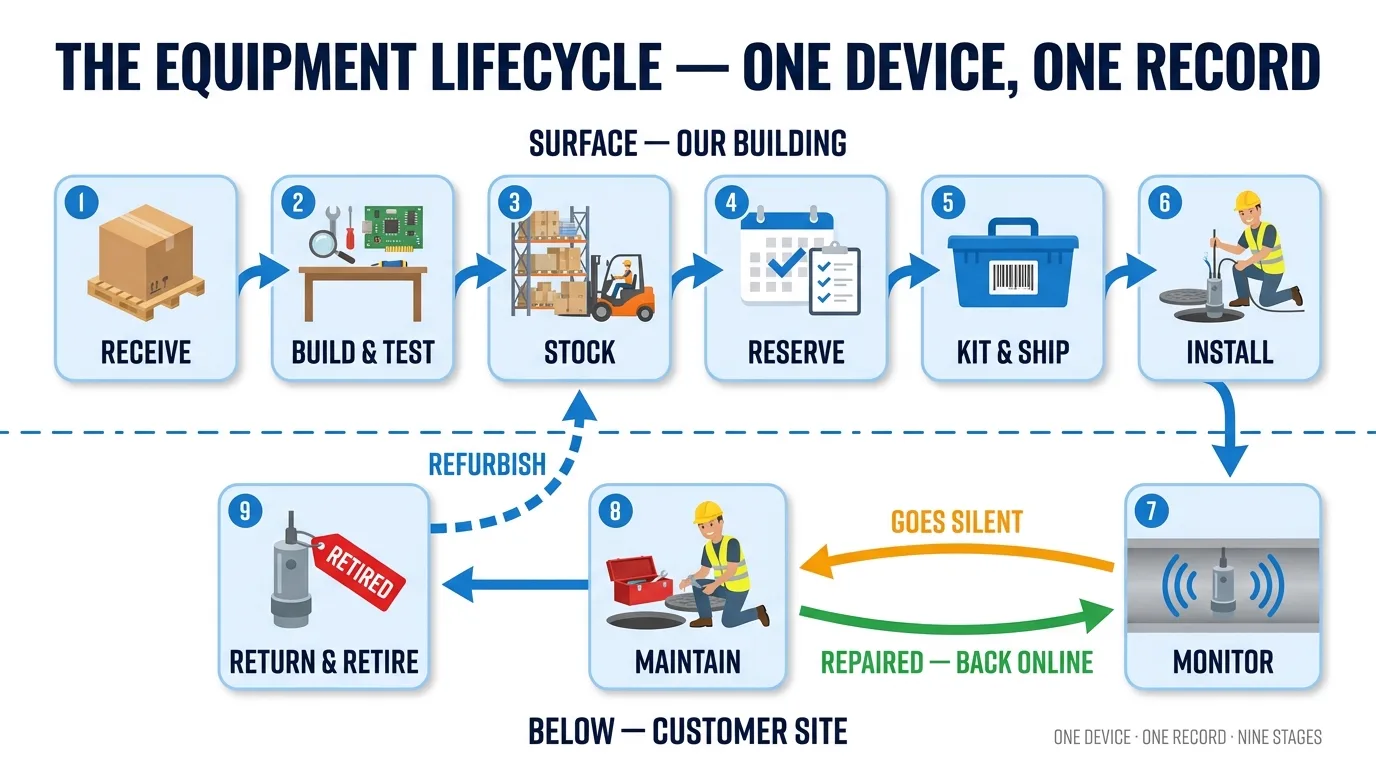
The equipment lifecycle: nine stages from receive to retire, above and below ground, in one loop
THE LOOP IS THE POINT — CLOSE IT, AND THE DEVICE TELLS YOU IT STOPPED

Today a device goes in the ground and you hear nothing until a customer calls. Close the loop and the device reports it stopped, someone goes out — and what they find changes how you build the next one.
Who runs on it

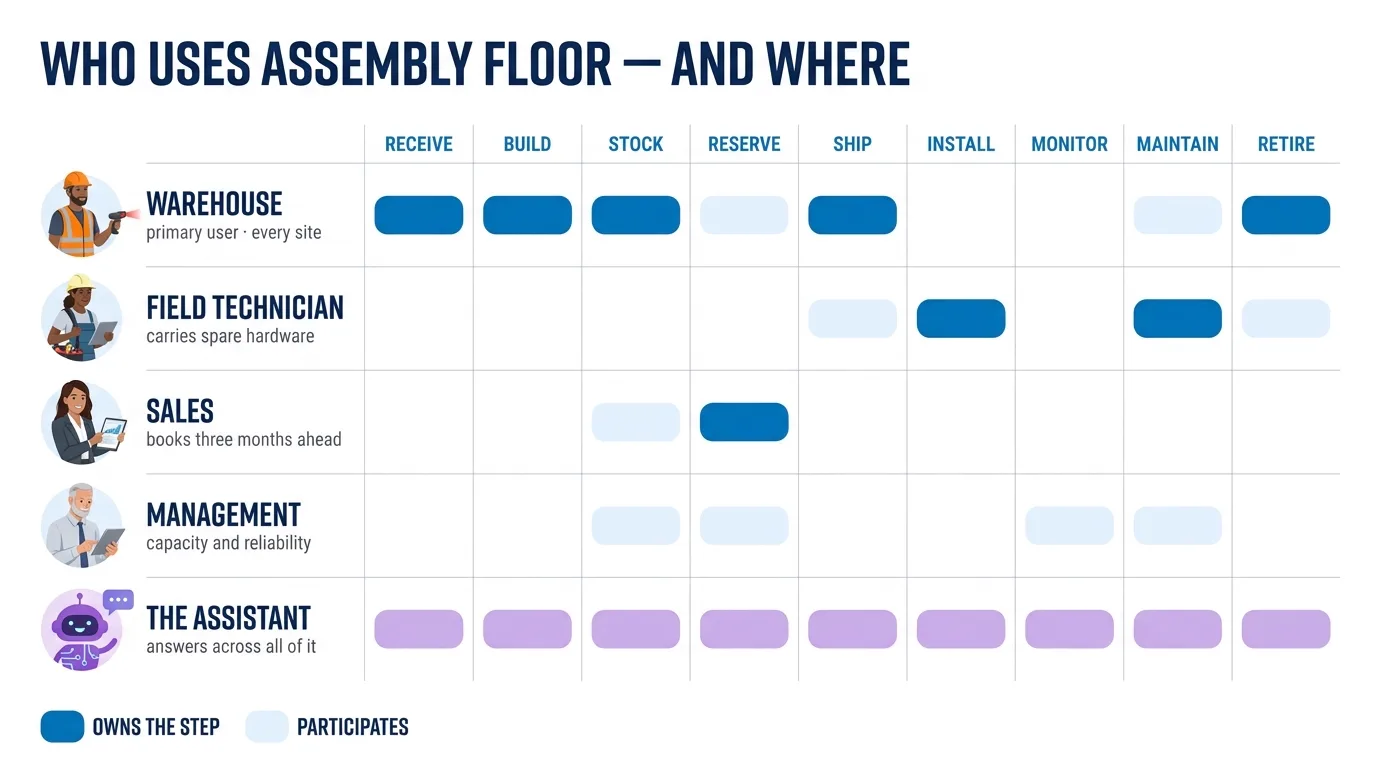
Warehouse first.

Where two groups disagree, the warehouse wins — it uses more of this system than anyone else. But every seat gets its part, and each of them stops doing something they hate doing today.

Matrix of who uses Assembly Floor across the nine lifecycle stages — warehouse, field technician, sales, management, and the assistant
THE WAREHOUSE ROW IS THE FULLEST ROW — THAT IS THE POINT
The floor, live

Every mechanism removes
a job somebody hates.

THINGS ARRIVING

Nothing arrives unnoticed.

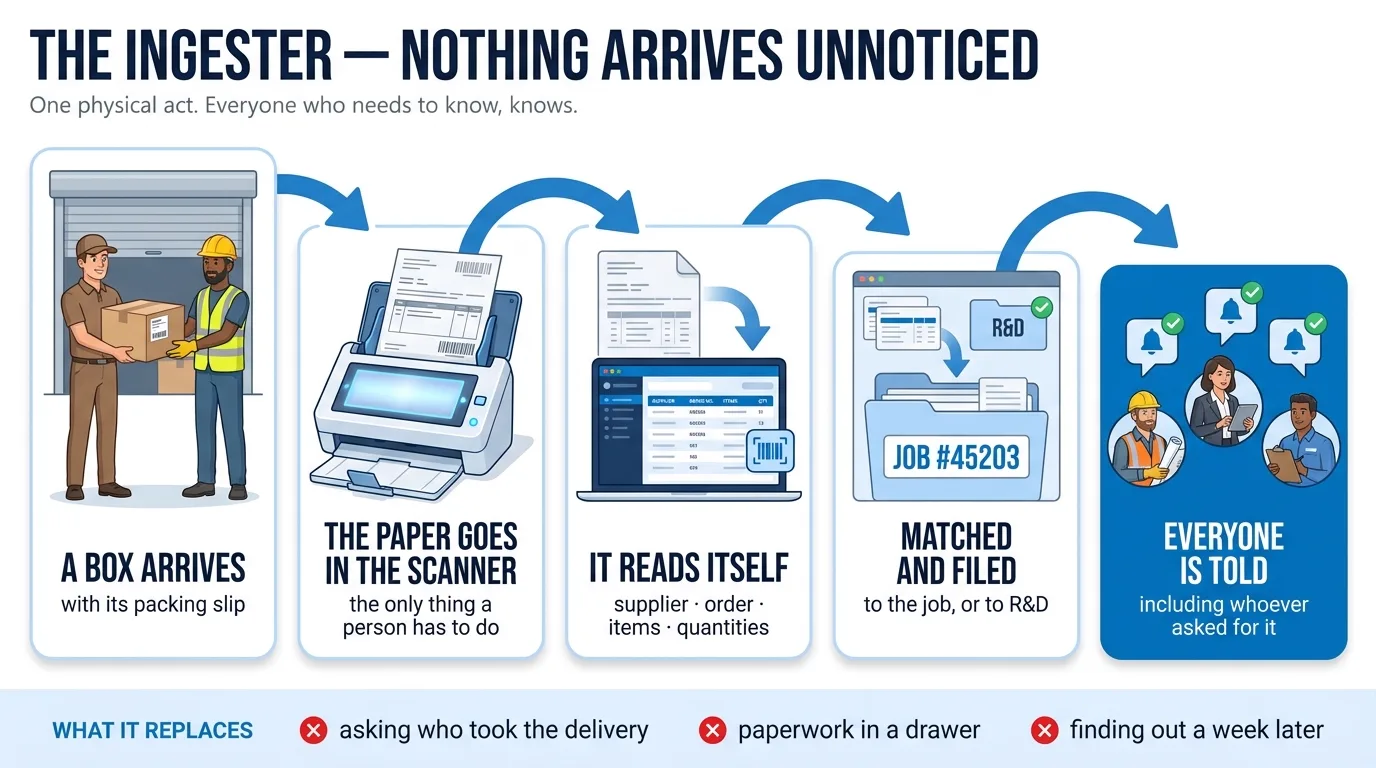
Every packing slip goes through one scanner. It reads itself — supplier, order, items, quantities — matches to the job, files itself, and tells whoever asked for the parts.

One physical act. Everyone who needs to know, knows.

The Ingester: a box arrives, the paper goes in the scanner, it reads itself, is matched and filed, everyone is told
THE PAPER GOES IN · THE DATA COMES OUT · EVERYONE IS TOLD
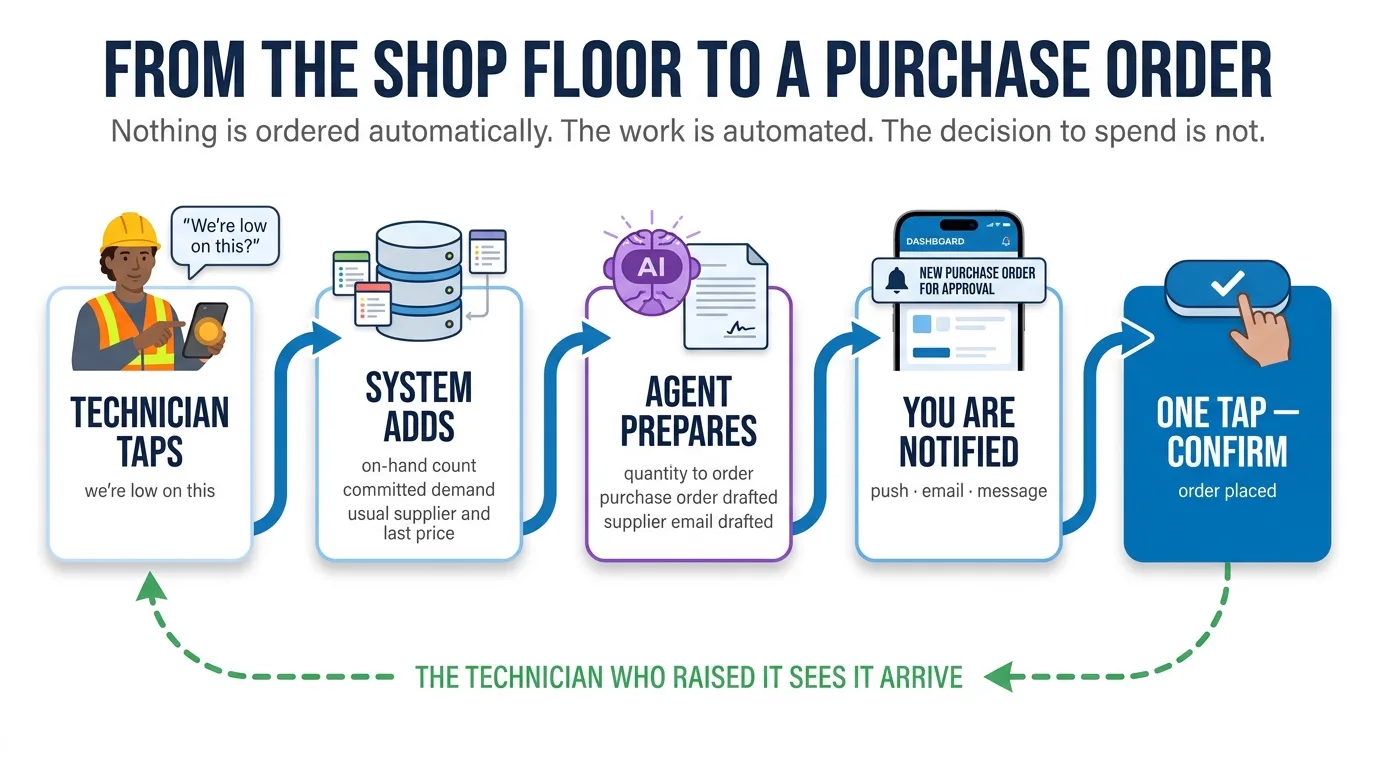
From the shop floor to a purchase order in five steps, ending with one tap to confirm
RUNNING LOW

The floor raises its own orders.

The person who knows you're running out is the one using the last of it. They tap once. The system adds counts, committed demand and last price; an agent drafts the purchase order and the supplier email; you confirm with one tap.

Nothing is ordered automatically. The work is automated. The decision to spend is not.

BRINGING DEVICES BACK

Red tag, green tag.

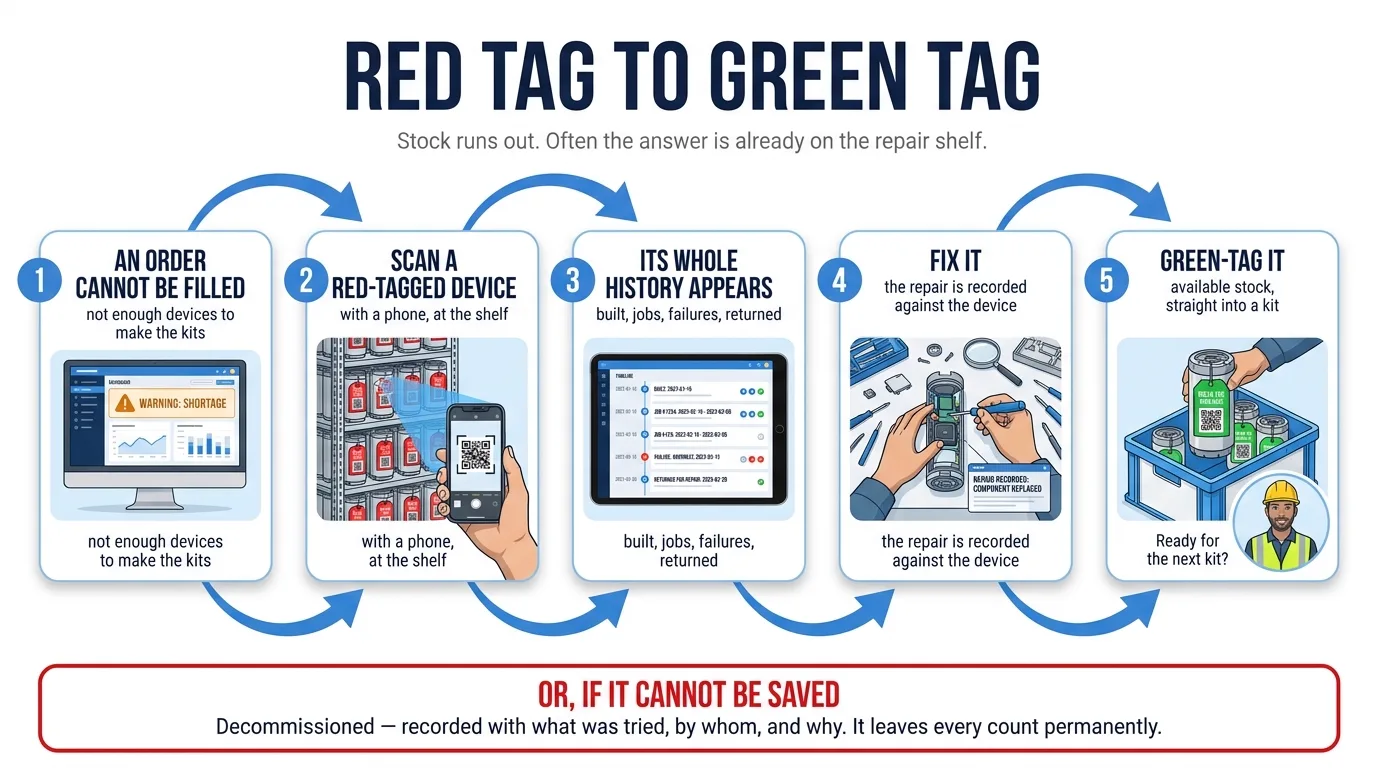
Stock runs out — and the answer is often already on the repair shelf. Scan a red-tagged device with a phone and its whole history appears: built, jobs, failures, returned two weeks ago, untouched since. Fix it, green-tag it, straight into a kit.

If it can't be saved, the same path ends in a decommission — recorded with what was tried, by whom, and why.

Red tag to green tag: scan a red-tagged device, its history appears, fix it, green-tag it, back into stock
SCANNED · READ · REPAIRED · GREEN-TAGGED · STRAIGHT INTO A KIT
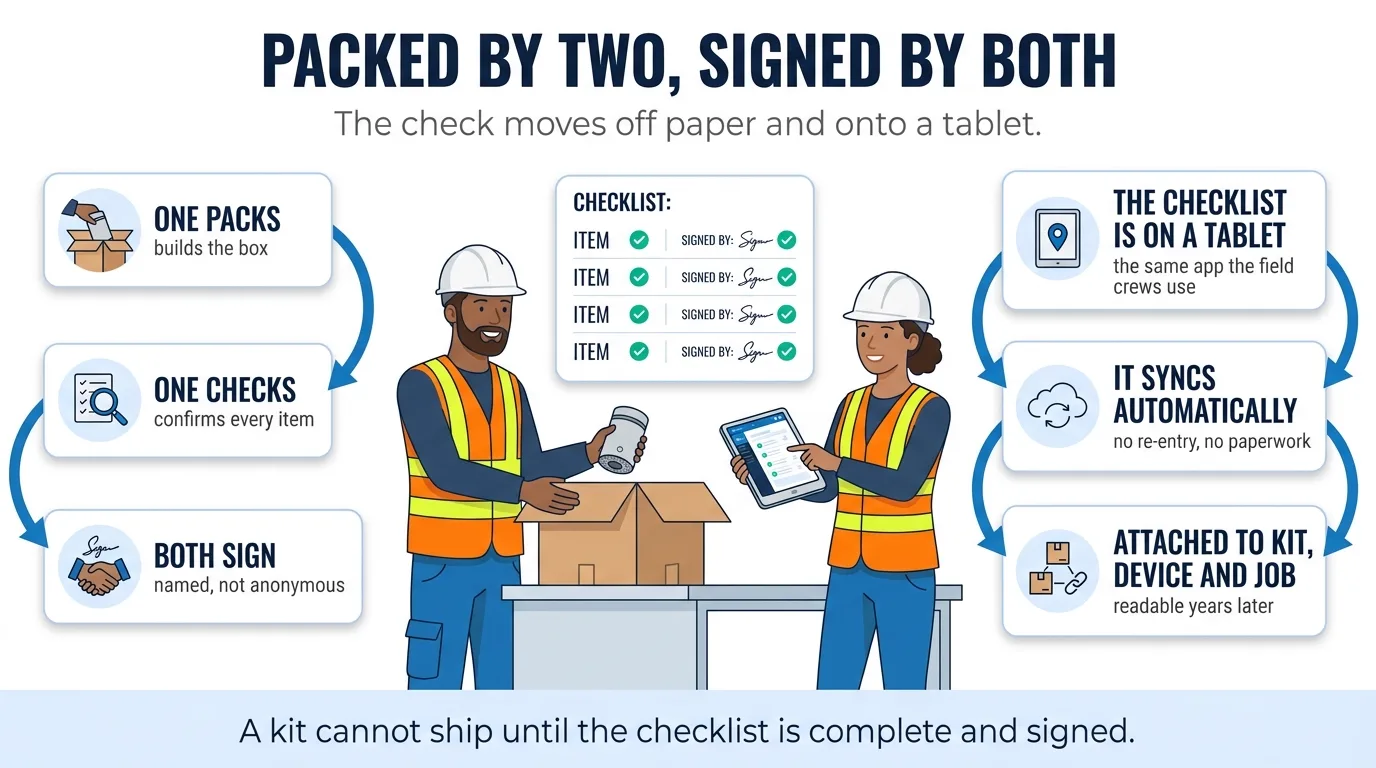
Packed by two, signed by both: one packs, one checks, both sign on a tablet, attached to kit, device and job
GOING OUT

Packed by two, signed by both.

Packing a box is a two-person job: one packs, one checks. That check moves off paper and onto a tablet — named signatures, not anonymous ticks — and syncs automatically.

A kit cannot ship until the checklist is complete and signed. It stays readable — from the kit, every device in it, and the job — years later.

Every device SERIAL 6872

One serial, one life.

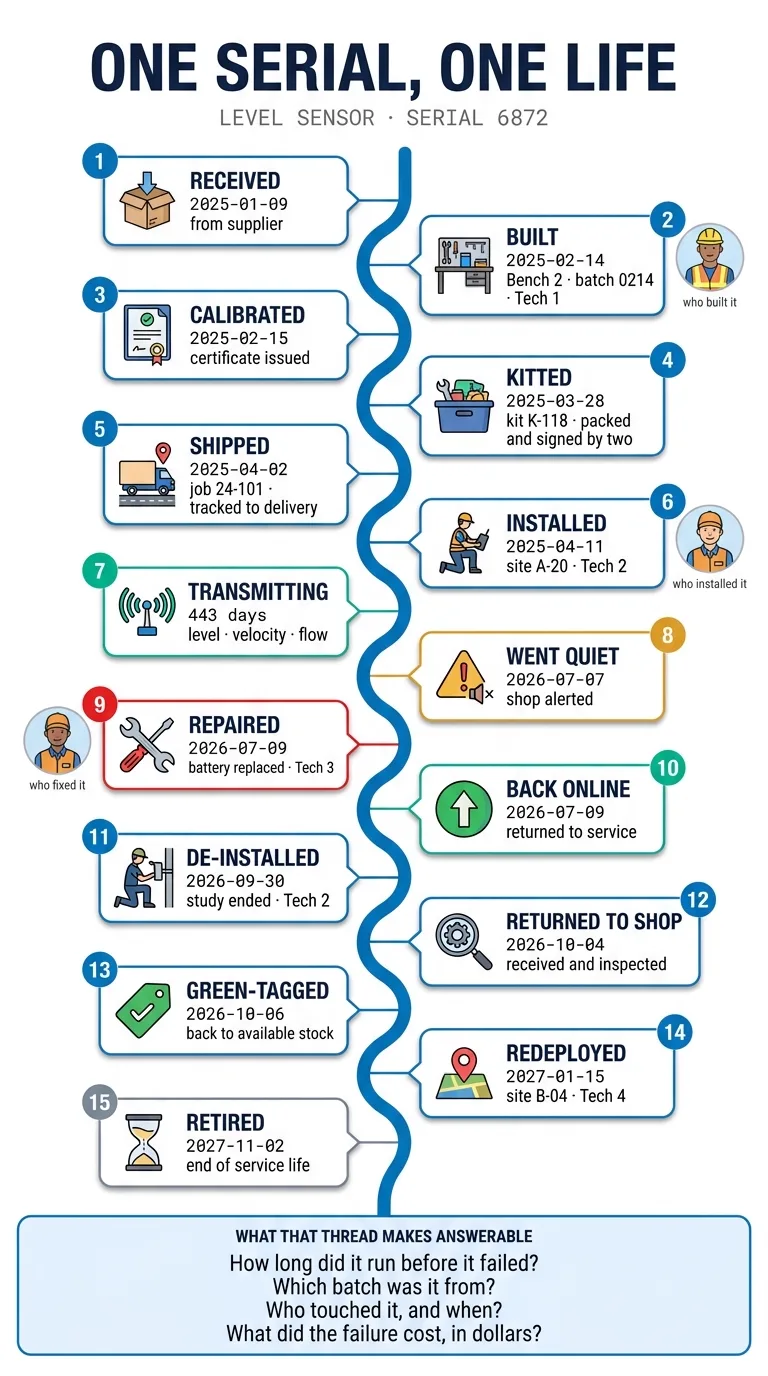
A device isn't a row in a stock list. It's an object with a history — built on a named bench in a named batch, shipped in a named kit, installed by a named technician at a named site. Transmitting, then quiet. Repaired, returned, redeployed. The history is what makes everything else possible.

  • Q1How long did it run before it failed?
  • Q2Which batch was it from?
  • Q3Who built it, installed it, fixed it?
  • Q4What did the failure cost, in dollars?

Read along one thread and every one of those answers itself. Multiply by the fleet, and reliability stops being an argument.

One serial, one life: fifteen milestones of a single device from received to retired on one vertical thread
FIFTEEN MILESTONES · ONE UNBROKEN THREAD

Down here, a device is working.

SITE A-20 · LEVEL · VELOCITY · FLOW · REPORTING NIGHTLY

Then it isn't.

No error. No message. The site data just stops arriving.

805days silent — and nobody knew

At the plant this platform was built in, one device sat dead in the ground for 805 days. The stock list said 74 devices were “available” while they sat in manholes.

Assembly Floor notices the day it happens.

ALERT — GONE QUIET
site A-20 · customer named · device 6872
silent 36 hours · was healthy · not in maintenance
replacement: in stock — build verified

Back online.

The replacement was tested before anyone drove out. The visit joined the device's history. The customer never called — you called them.

The field, watched

A device that goes quiet
raises its own alarm.

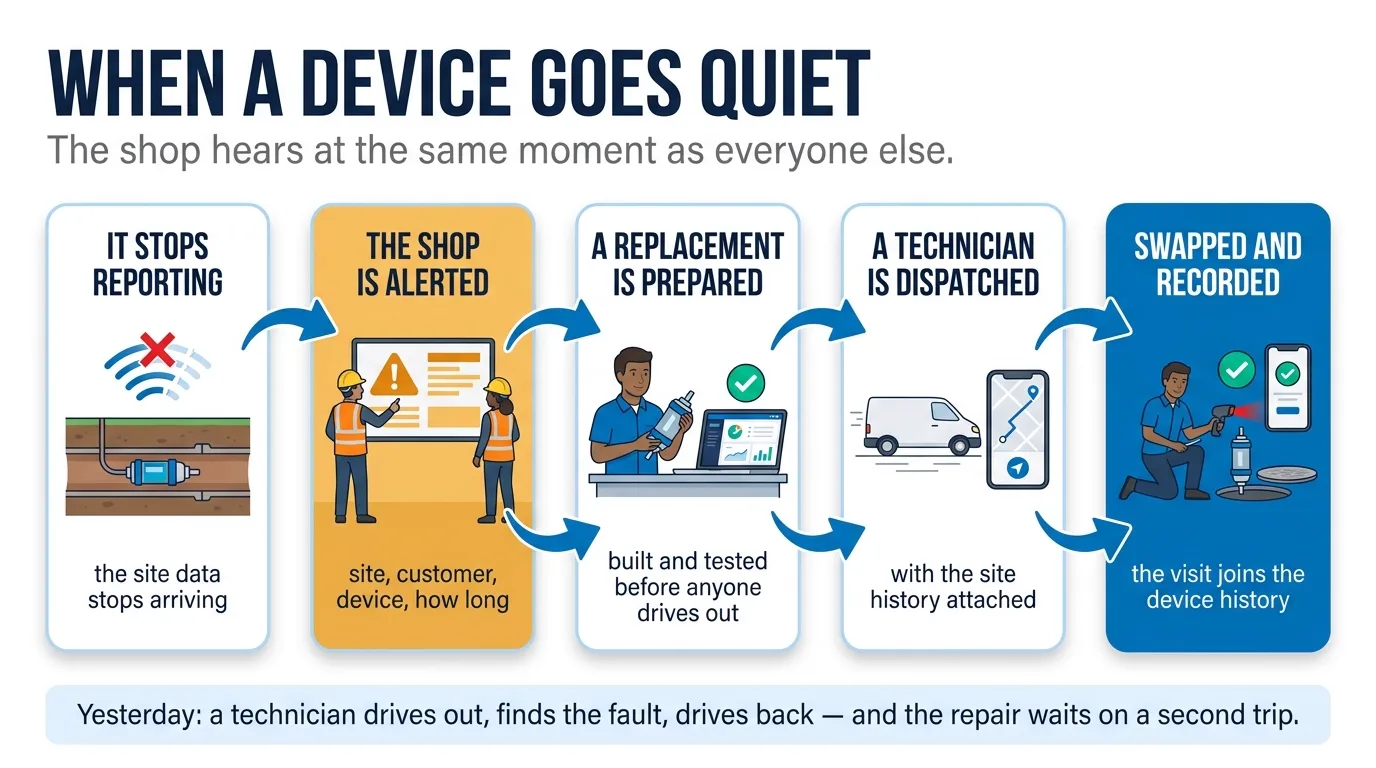
Every alert names the site, the customer, the device, and how long it has been quiet. Devices switched off on purpose never alert — a disposition gate separates outage from maintenance from dormancy, so an alarm means something every time.

When a device goes quiet: it stops reporting, the shop is alerted, a replacement is prepared, a technician is dispatched, swapped and recorded
THE SHOP HEARS AT THE SAME MOMENT AS EVERYONE ELSE
805 days
longest silence found on a real floor — before
74
devices “available” while sitting in manholes — before
36 hrs
a typical gone-quiet alert — after
Diagnosis

What broke, and why.

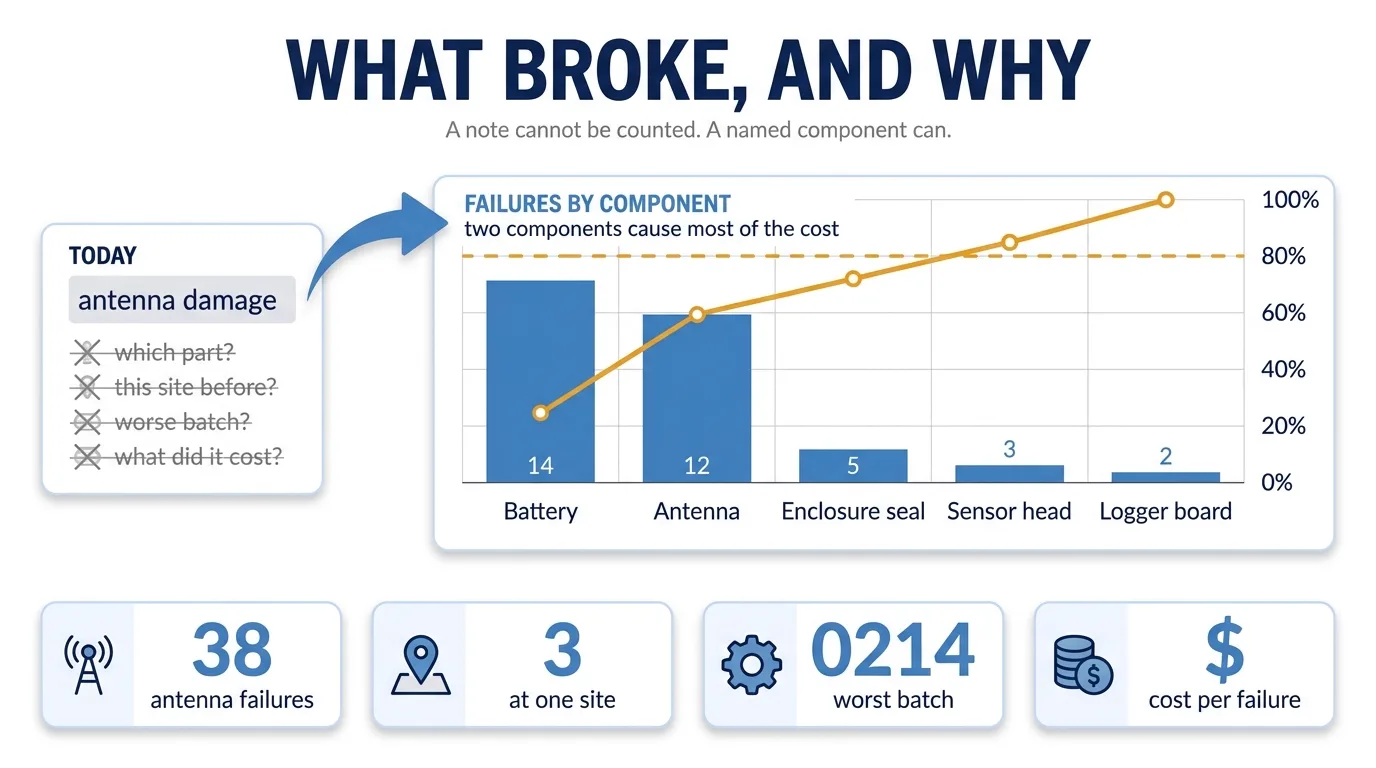
“Antenna damage” in a box is a note. The same failure against a named part, counted across the fleet, is a diagnosis. Two components cause most of the cost — you cannot see that from free text.

What broke and why: failures by component with a cumulative cost line — two components cause most of the cost
SITE DIAGNOSIS

Is it the device, or the hole?

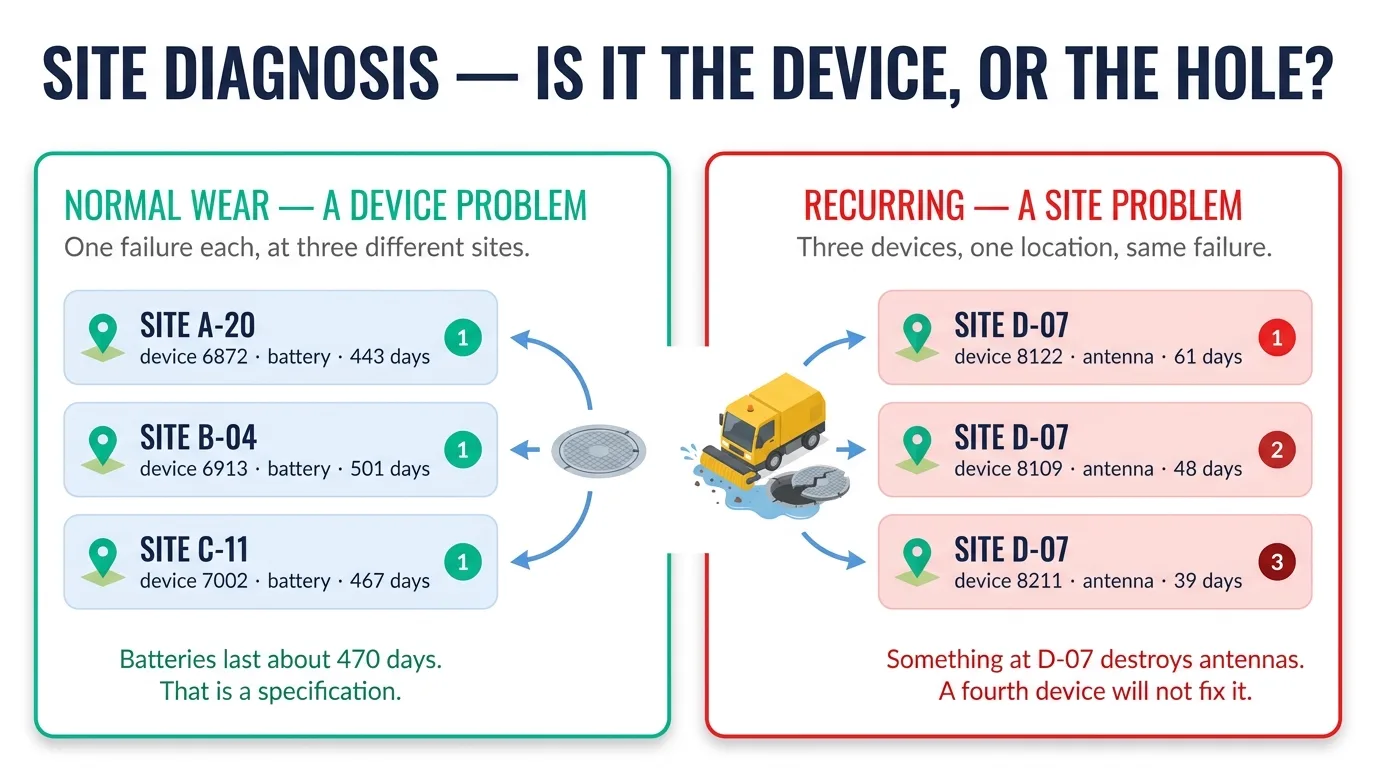
Some sites eat equipment. Replace the device and it fails again — because the device was never the problem. Repair history hangs off the site, not the device, so it survives every swap.

Three batteries at three sites is a specification. Three antennas in one hole is a diagnosis.

Site diagnosis: one failure each at three sites is normal wear; three identical failures at one site is a site problem
The intelligence

Ask the Foreman.

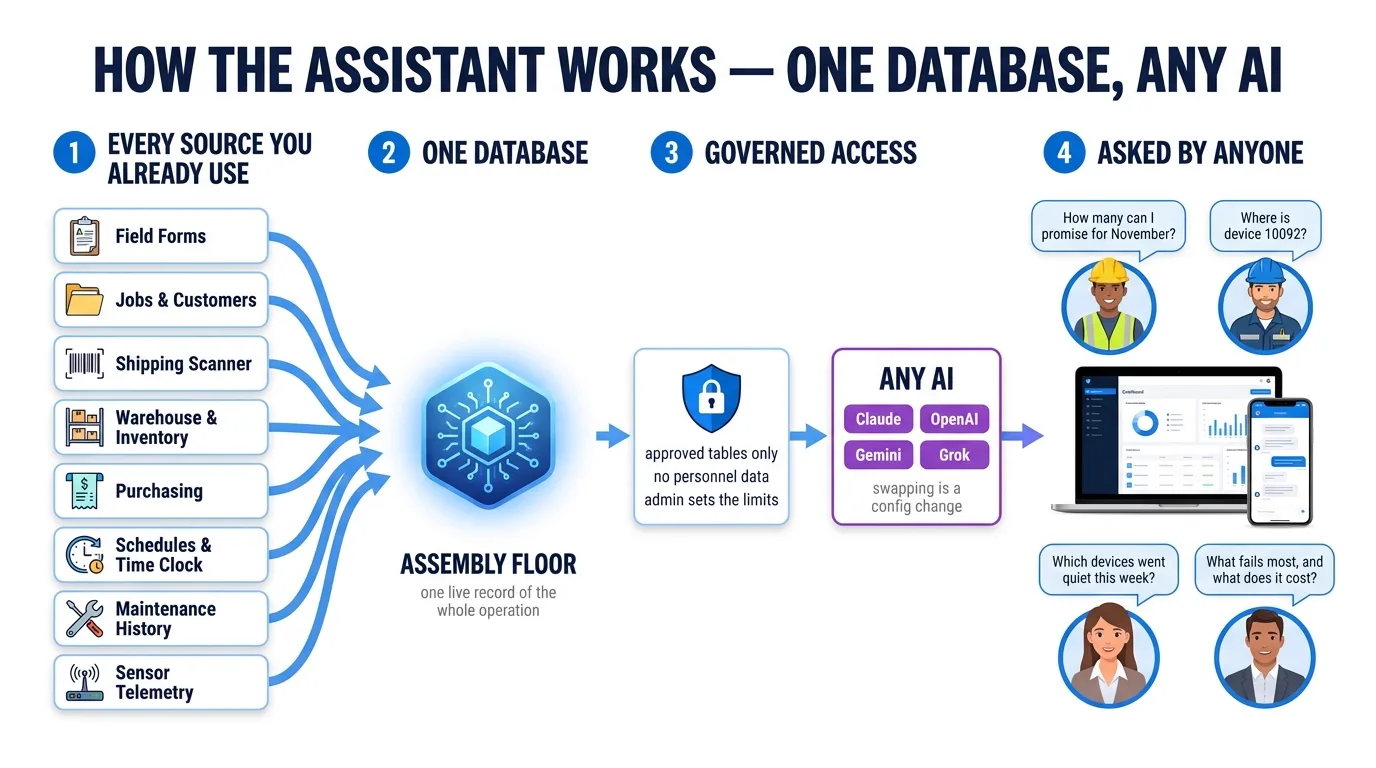
Every number in the system, in plain language, without knowing where it's kept. The Foreman runs over one live database with governed access — approved tables only, no personnel data, the admin sets the limits.

How many can I promise for November? Where is device 10092? Which devices went quiet this week? What fails most, and what does it cost?
How the assistant works: every source flows into one database, through governed access, answered by any AI, asked by anyone
ANY AI PROVIDER — SWAPPING IS A CONFIG CHANGE, NOT A REBUILD
UNDERNEATH IT

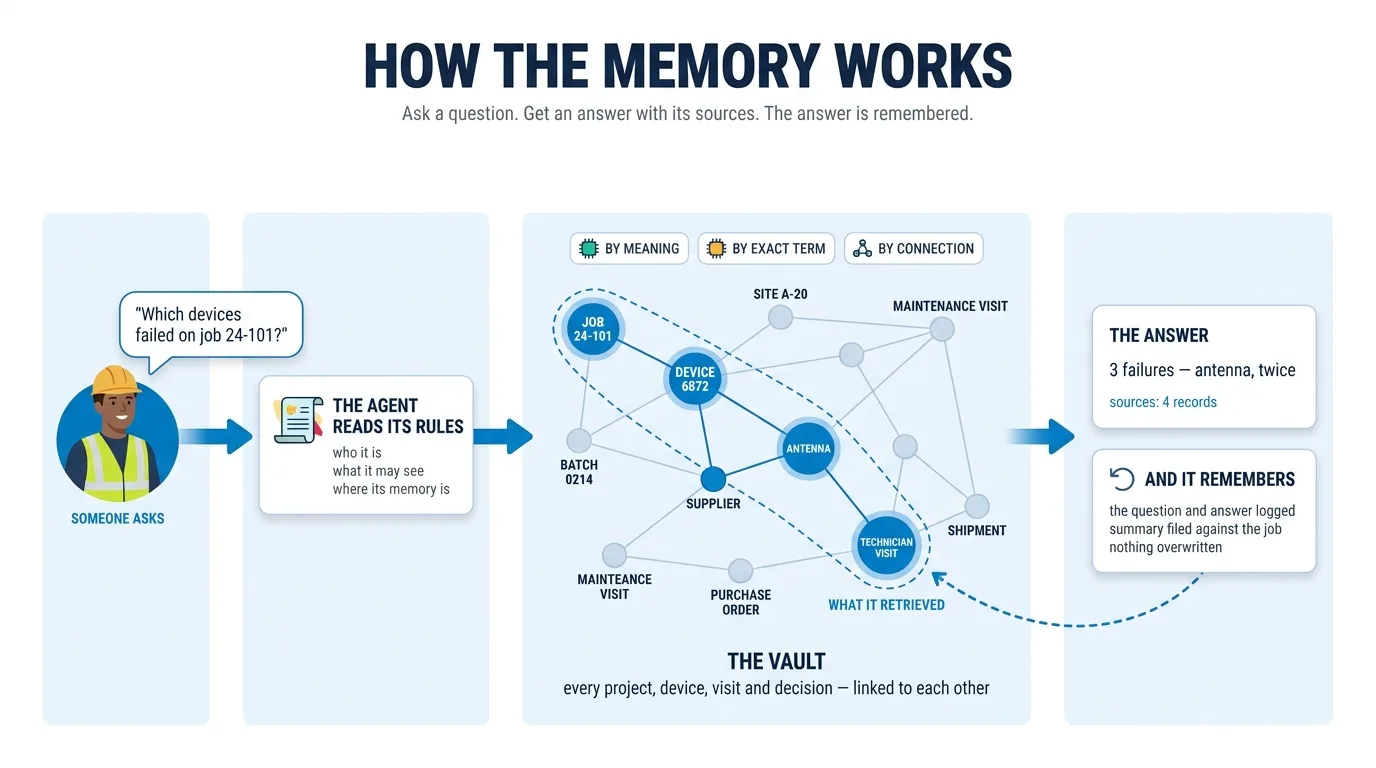
The memory it runs on.

The Foreman isn't a chatbot bolted on. It runs on a persistent memory layer every future agent shares — the operation's institutional memory, kept.

  • Append-onlyNothing is ever overwritten.
  • Answers carry sourcesAnything can be checked.
  • Permissions before retrievalRestricted data is never fetched.
  • Behaviour is dataChange it with an edit, not a release.
How the memory works: a question retrieves by meaning, exact term and connection from one linked record, and the answer is remembered with sources
Beyond the floor

The office stops walking
to the warehouse.

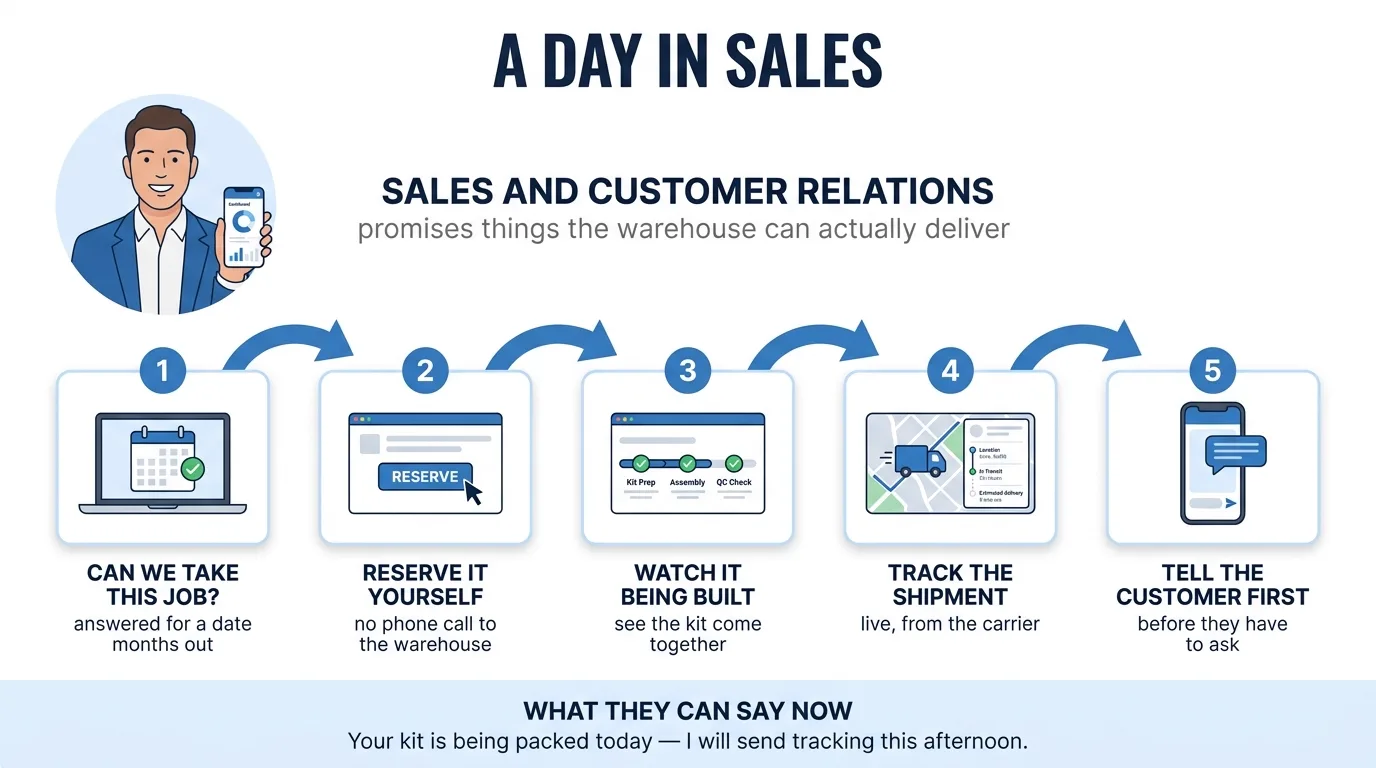
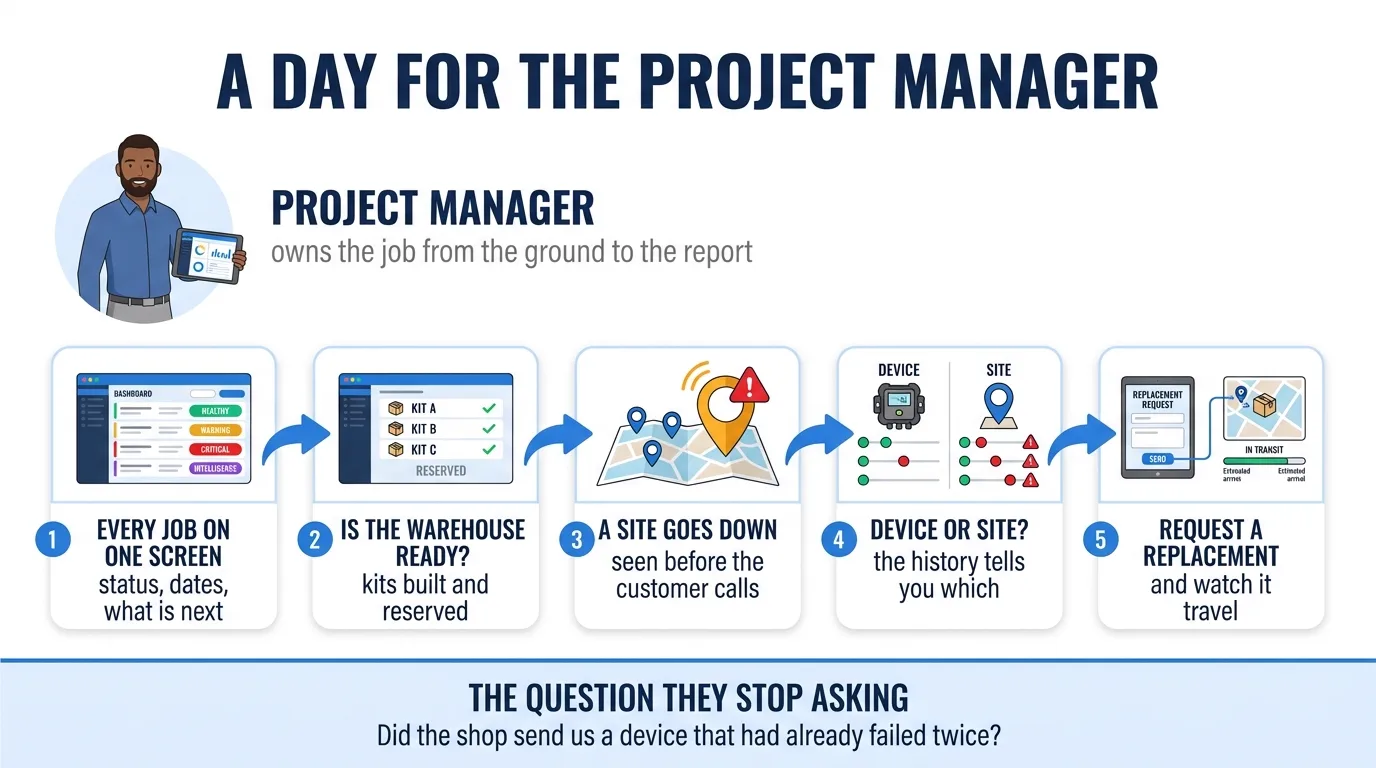
Sales answers availability months out and reserves it without a phone call. Project managers see every job on one screen — and when a site goes down, whether it's the device or the hole. Accounting learns a job ended without chasing anyone.

A day in sales: check availability, reserve it, watch the kit being built, track the shipment, tell the customer first
A day for the project manager: every job on one screen, a site goes down, device or site, request a replacement
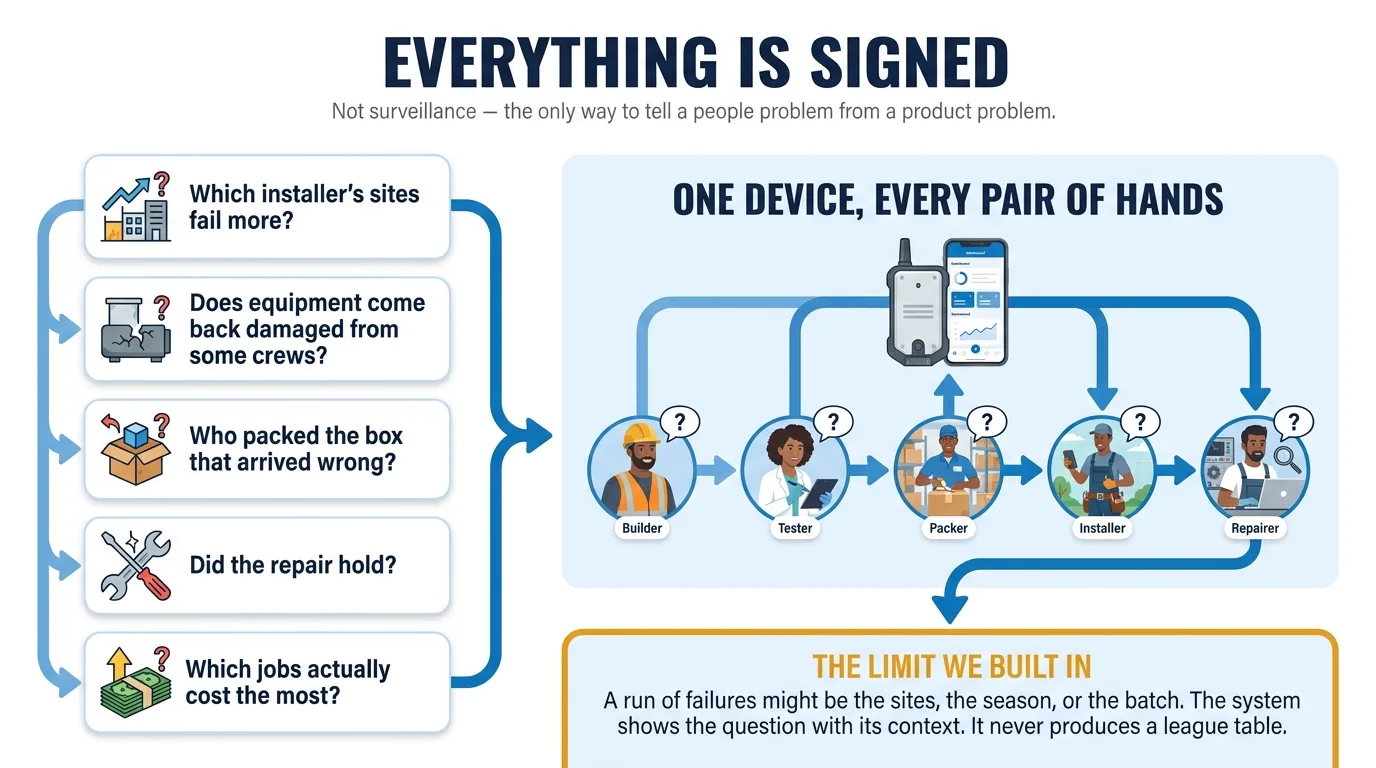
Everything is signed: one device, every pair of hands — with a built-in limit: it never produces a league table

Everything is signed — not surveillance, but the only way to tell a people problem from a process problem from a product problem. A deliberate limit is built in: the system shows the question with its context. It never produces a league table.

Where it comes from

Built on a real floor.

Assembly Floor wasn't designed in a pitch deck. It was built inside a wastewater instrumentation manufacturer — multiple warehouses, field crews, serialised devices living for years underground — to fix that company's own worst weeks.

The 805-day silence is theirs. The 74 ghost devices are theirs. The failure record that couldn't be counted is theirs. The fixes are what you're looking at. The full build — 22 chapters, every mechanism — is public in the explainer.

Talk to us

See it on your own floor.

Twenty minutes, your use case, no deck. Tell us what you make and what goes quiet.

We'll show the parts that map to your floor — receiving, kitting, the field, the watcher, the assistant — on live data, not slides.

No mailing list. No tracking. Your message goes to a person.